


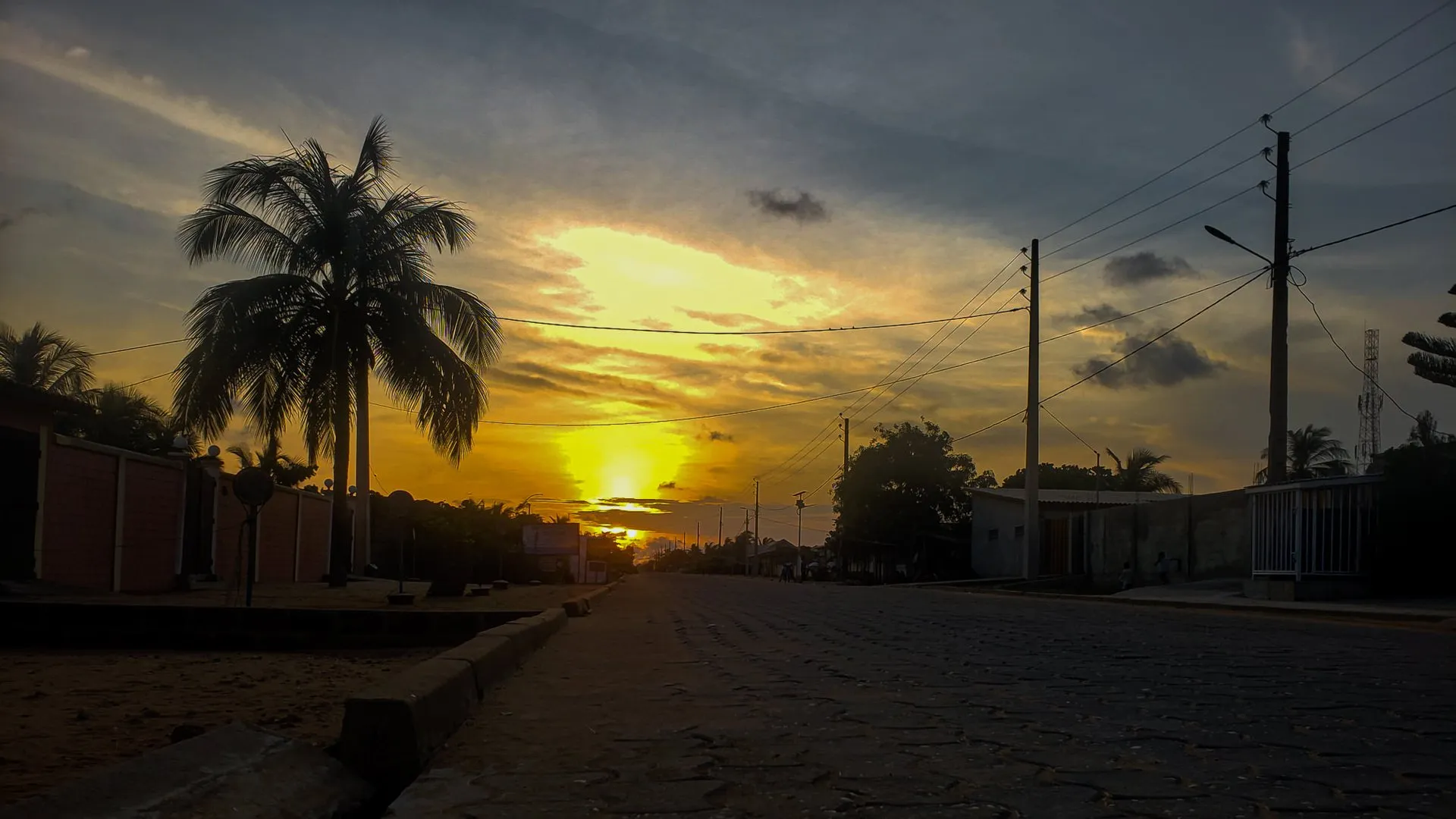
The Fishing Route is far more than a road: it is the backbone of the Beninese coastline, an ochre ribbon linking historic towns to the wild Atlantic beaches. From Cotonou to Grand-Popo, this legendary track crosses landscapes of raw beauty, between coconut groves, mangroves and fishing villages.
What the Fishing Route actually is
The Route des Pêches stretches about 60 kilometres between Cotonou's beaches and the foothills of Grand-Popo. It is not a modern paved road but an ochre earth track, lined with coconut palms, winding with the coast's caprices.
Its name comes from the fishermen who use it daily to reach their pirogues. For decades, it was the only link between coastal villages and the rest of the country. Today it has become an unmissable tourist itinerary — not despite its rough surface, but because of it.
The surface is beaten earth, sometimes sandy, with sections deformed by rain and repeated lorry traffic. It is a road that forces you to slow down. A standard car can manage in dry season; a 4x4 or high-clearance vehicle is recommended after rain or in the June to October wet season. Maximum speed on most sections: 30 to 40 km/h. You will need 1.5 to 2.5 hours for the full 60-kilometre stretch, not counting stops — and stops are the whole point.
To understand the history and legend of this road, discover the legend of the Fishing Route below.
Full-day itinerary from Grand-Popo
Exploring the Fishing Route means giving yourself a full day of discovery. Here is a typical programme starting from Grand-Popo.
Departure from Grand-Popo — 8:00am
Head east toward Ahozon then Avlo. The road runs along the coast for about ten kilometres before leaving the last houses behind and entering the coconut grove. Morning is the best time: soft light, cool air, the track is less busy with cargo vehicles.
What to bring: 2 litres of water per person, snacks (sellers are irregular on the track), sunscreen, a hat, and enough fuel for 120 km if going all the way to Ouidah and back.
Stop 1 — Avlo and Gle beaches — 8:30am
The first coastal villages offer open views of the ocean and the clearest picture of daily life on the coast. Stop to contemplate the pirogues scattered on the sand. Fishermen prepare their nets from dawn; by 8:30am the ones who left at 4am are already back, sorting their catch.
At Avlo: the village has a tourist infrastructure — ecolodges, beach restaurants open for lunch — but remains genuinely residential. The wooden bridge spanning the lagoon between Avlo and Ahozon is worth a stop: cross on foot for a 360-degree view of pirogues, waterbirds and the narrow strip of land between ocean and lagoon.
At Gle: more raw and less visited. Mud-brick houses, powerful surf, no vendors. A good place to simply stand and listen to the Barre breaking.
Stop 2 — Bouche du Roy — 9:30am
Halfway between Grand-Popo and Ouidah, Bouche du Roy is where the Mono River meets the ocean. The site is impressive: a vast expanse of lagoon water surrounded by mangroves. A pirogue excursion is the main activity. See our Bouche du Roy guide for details.
Pirogue cost: 2,000 to 5,000 FCFA for the basic crossing; 8,000 to 15,000 FCFA for a 1.5 to 2-hour tour of the lagoon channels. Fix the price before boarding.
Wildlife: herons, egrets, kingfishers and pelicans (dry season). Mangrove crabs visible in the roots at low tide. Occasionally, manatees in the deep channels — ask the fisherman if any have been seen recently.
Stop 3 — Mangrove crossing — 10:30am
The road crosses a particularly dense mangrove zone after Bouche du Roy. Slow down: you may spot birds, crabs and sometimes monkeys in the canopy. The trees change colour with the light — blue-grey at dawn, vivid green by mid-morning.
Stop 4 — Ouidah — 11:30am
Ouidah, the historic Slave Route town, deserves a two to three-hour stop on a Fishing Route day. Visit Place Chacha, the Python Temple, the cathedral and the Door of No Return. All details in our article on the Grand-Popo to Ouidah excursion.
What is realistic in 2 to 3 hours: Python Temple (30 minutes, 1,500 FCFA) + walk to the Door of No Return (45 minutes each way) + 30 minutes on the beach. That leaves the History Museum and Sacred Forest for a dedicated full-day visit.
Lunch — 1:00pm
Several options in Ouidah or on the beach along the way. Restaurant Chez Maman Gisele on the road to Ouidah is a reliable choice for grilled fish (3,000 to 5,000 FCFA). In Ouidah itself, Le Jardin du Monde faces the beach near the Door of No Return (7,000 to 12,000 FCFA).
Return to Grand-Popo — 3:00pm
Take the road back in reverse. The afternoon light offers different colours on the landscape — deeper ochres, longer shadows through the coconut palms. Stop at a viewpoint to admire the coast.
Arrive in Grand-Popo — 5:00pm
Evening falls. Head to Lion Bar for sunset and a well-deserved glass of sodabi.
Coastal villages: four stops worth knowing
The villages bordering the Fishing Route are the guardians of an ancestral way of life. Each has a distinct character.
Gle — the most authentic
Mud-brick houses, pirogues beached on the sand, children playing in the waves. Gle is the authentic face of Beninese artisanal fishing. No tourist infrastructure here — you are a guest, not a customer. Greet people, move slowly, ask before photographing.
The Barre breaks powerfully at Gle. The beach is beautiful and wild but not safe for swimming — the currents are strong and unpredictable. Ask a local before entering the water anywhere on this coast.
Avlo — the touristic hub
The most visitor-friendly village on the route. Several ecolodges welcome day visitors for lunch (book in advance). The atmosphere is both relaxed and lively. Avlo is the best base if you want to spend a night on the Fishing Route without staying in Grand-Popo.
Ahozon — the gateway
Residential area mixing expat villas and traditional houses. The Ahozon jetty is the departure point for pirogue excursions on the Mono River and Lake Ahome. Good for fuel and supplies before hitting the track.
Hillacondji — the border village
A few kilometres from Grand-Popo, Hillacondji sits on the Bénin-Togo border. Its daily market is a commercial crossroads between the two countries: textiles, produce, household goods crossing back and forth. The atmosphere is busy and authentic.
To discover the people of these villages, our article on the Xwla people dives into their history and culture.
Fishermen: the daily battle with the Barre
Fishing is the main economic activity of the coast. Every day, hundreds of fishermen face the Barre — the powerful wall of waves that characterises the Beninese coast. Launching a pirogue through it requires timing, strength and years of practice. The hull hits each wave as a man might hit a wall; the fishermen lean back and drive through.
Pirogues leave at dawn, sometimes from 4:00am. Fishermen use traditional nets and lines. Species caught are varied: capitaine (Nile perch), dorado, barracuda, tuna, jack.
The return of the pirogues is a spectacle in itself. Women wait on the beach to buy fish wholesale for resale at the market. Negotiations are lively, laughter abounds. If you are on the track by 7:00am, you may catch the end of this morning activity at Gle or Avlo.
To experience this from the inside, our article on artisanal fishing in Grand-Popo invites you to go to sea with a fisherman before dawn.
Viewpoints: four spots not to miss
Bouche du Roy belvedere
From the small belvedere on the eastern bank, the view takes in the Mono River mouth, the ocean and the lagoon simultaneously. Spectacular at sunset, but also beautiful in the morning when mist still hangs over the water.
Avlo coconut groves
A few hundred metres from the beach, the coconut plantations offer shaded, photogenic avenues. The light between the trunks in the early morning is particularly striking.
Gle beach
One of the most beautiful beaches on the coast. Fine sand, powerful waves, no buildings in sight. An end-of-the-world feeling that is rare on the increasingly developed West African coast.
The Avlo lagoon bridge
Cross the wooden bridge spanning the lagoon between Avlo and Ahozon on foot. The view of pirogues and birds in both directions is one of the Fishing Route's most photogenic moments. Allow 10 minutes for the crossing.
Where to eat on the Fishing Route
Chez Paterne (Grand-Popo)
Beach institution, grilled fish and prawns. Our dedicated article gives all the details: Chez Paterne. Best for dinner before or after the route.
Chez Maman Gisele (on the road to Ouidah)
Local restaurant specialising in fresh fish grilled over wood. Expect 3,000 to 5,000 FCFA (4.57 to 7.62 EUR) per dish. No menu — ask what came in that morning.
Bouche du Roy restaurant
Simple cuisine facing the lagoon. The sautéed prawns are excellent and the location is hard to beat. Open for lunch only; confirm availability before counting on it.
Ecolodges (by reservation)
Several ecolodges in Avlo offer lunch for passing visitors. Our selection of the best ecolodges includes those that welcome day visitors. Call or WhatsApp the evening before.
For a fruity break between stops, fresh coconut sellers work the track regularly. Expect 200 to 300 FCFA (0.30 to 0.46 EUR) per nut; they will open it with a machete and add a straw.
Practical tips for driving the Fishing Route
- Leave early: morning light is beautiful, the track is cooler and cargo lorries are less active before 10am
- Take an adapted vehicle: a standard car can manage the full route in dry season; a 4x4 or SUV is more comfortable and safer after rain
- Bring water and snacks: sales points are irregular — a good rule is to carry everything from Grand-Popo
- Fill up in Grand-Popo: petrol stations are absent on the track; the first reliable one after Grand-Popo is in Ouidah
- Respect the villages: slow down in inhabited areas; children play by the roadside and chickens cross without warning
- Do not drive at night: the track is unlit and livestock sometimes cross after dark
For longer journeys incorporating the route, our article on the Grand-Popo to Cotonou trip gives all the transport options.
FAQ
How long is the Fishing Route? About 60 kilometres from Cotonou to Grand-Popo.
Can I drive it in a standard car? Yes in dry season. After rain, a 4x4 is strongly recommended for the sections between Avlo and Bouche du Roy.
How long does it take? Allow 1h30 to 2h30 without stops. With stops at Gle, Avlo, Bouche du Roy and Ouidah, budget a full day.
What is the best time of day? Morning for light, lower temperatures and the end of the early-morning fishing activity in the villages.
Are there petrol stations? None on the track itself. Fill up in Grand-Popo before leaving. The next station is in Ouidah.
Can I cycle the route? Yes, but it is demanding — some sections are deep sand. Fit cyclists enjoy it as a two-day adventure, sleeping in Avlo ecolodges. A GPS track is useful as the route forks in several places.
Plan Your Visit
Discover the magic of Grand-Popo with our curated local experiences.