



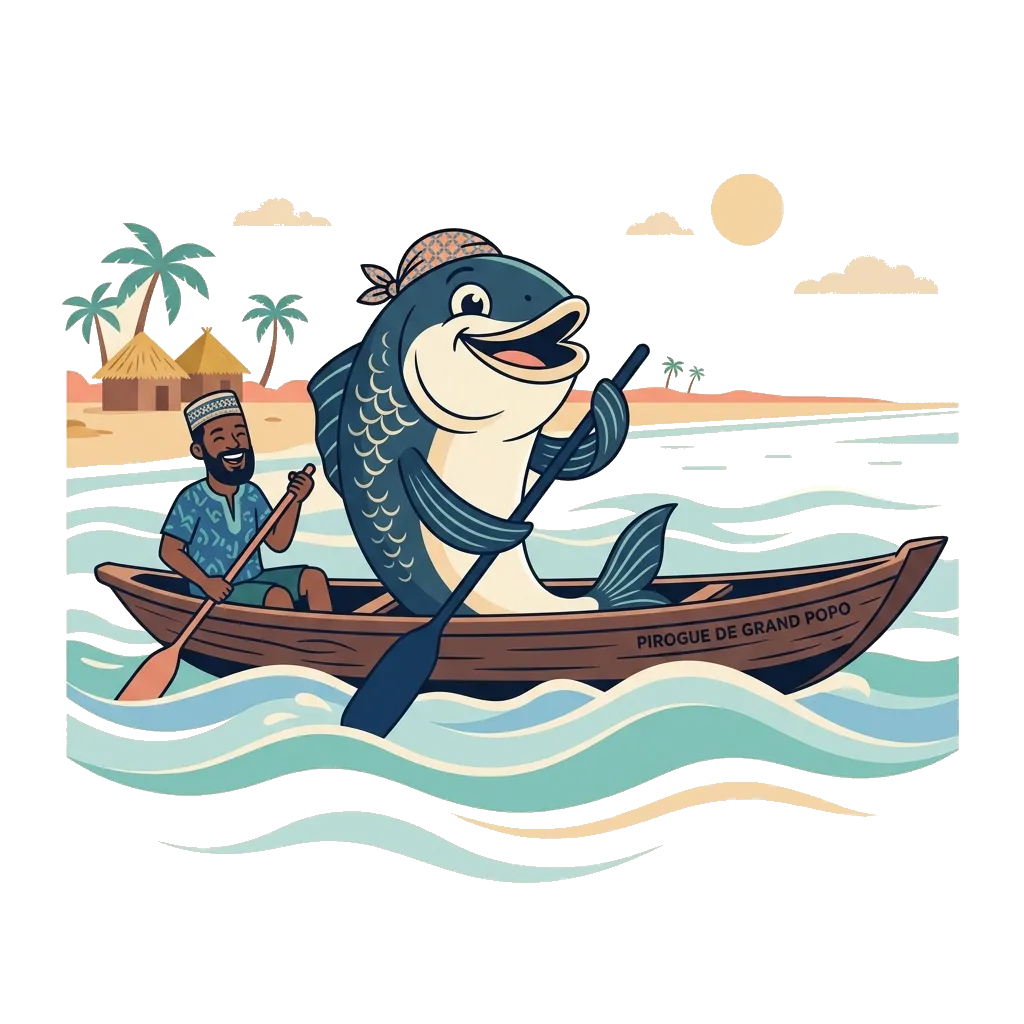
In Grand-Popo, the sea is not a backdrop. It is a demanding yet generous mother, the economic and cultural lung of the region. The artisanal fishing Grand-Popo experience is perhaps the most authentic immersion you can have on the Beninese coast. No industrial trawlers here: just men, carved wood, and an intimate knowledge of Atlantic currents passed down through generations.
Spending a morning with the Xwla fishermen is to enter the heart of Grand-Popo's identity. It means understanding the sacred relationship these people have with the ocean, sharing their efforts, their songs and their pride. An experience that transforms how you see the sea and those who live from it.
For an overview of what Grand-Popo offers, see our guide to Grand-Popo activities. And if the sea draws you, also discover the fresh seafood of the day that arrives directly from this fishery.
How fishing shaped Grand-Popo's identity
Fishing is far more than an economic activity in Grand-Popo. It is the foundation of Xwla culture. For centuries, the people of this coast have developed a unique expertise to face the Atlantic and draw from its waters enough to feed their families and sustain their communities.
Fishing techniques have changed little over time. Pirogues are still built by hand, nets are braided by the fishermen themselves, and fishing trips are blessed by Vodun priests before the first launch. Every gesture carries meaning and respect for the ocean, perceived as a living force that must be honoured, not dominated.
The smell of salt and woodsmoke lingers over the village from before sunrise. By 5am, the beach already hums with low voices, the scrape of hull on sand, the slap of rope against wood. This is how Grand-Popo wakes up: not to an alarm clock, but to the tide.
The fishing cycle sets the rhythm of village life. Departures before dawn, the return of pirogues mid-morning, the sale on the beach, the preparation of fish: everything revolves around this ancestral activity. Even the calendar is marked by fishing seasons and biological rest periods, a self-imposed discipline that preserves stocks without any outside regulation.
The Xwla: a people born from the sea
The Xwla people, who founded Grand-Popo, are a fishing people. Their very name means "those who live near the water" or sometimes "fishermen," according to oral tradition. This maritime identity lies at the heart of their culture, foundation myths and social organisation.
To understand the deep bond between the Xwla and the sea, our guide to the Xwla people of Grand-Popo explores their traditions and heritage.
Each fisherman knows the currents as he knows his own face. He knows where the fish hide depending on the season, what time the tide is most favourable, how to read the signs of sky and wind to predict the weather. This empirical knowledge, acquired through years of observation and practice, is as precise as any instrument reading.
Fishermen work in tight-knit teams, often made up of family members. Fathers pass their knowledge to their sons, who will pass it to their own children. Each team has its secrets, its techniques, its preferred fishing grounds. Knowledge is never written down. It lives in the hands, the eyes, and the memory of those who go out every morning before the rest of the village stirs.
Some teams have worked the same stretch of water for four or five generations. They know which sandbar shifts after a storm, which current to read when the harmattan blows from the north.
Inside a pirogue: wood, ritual and balance
The pirogues of Grand-Popo are genuine works of craft. Carved from massive tree trunks, mahogany, iroko or fromager, they are shaped with admirable precision. Each pirogue is unique, adapted to its owner and intended use.
Building a pirogue is a process that can take several weeks. The tree is felled with specific rituals, the trunk is shaped with axe and adze, then hollowed out progressively. The sides are thickened at points that will bear the most stress, while prow and stern are tapered to cut through waves. The final hull is so tightly fitted that it requires almost no caulking: the wood itself does the work.
Once finished, the pirogue is painted in bright colours and often decorated with philosophical or religious slogans. Some bear evocative names. Before its first launch, it is blessed by a Vodun priest who asks the sea spirits to protect the crew. A small offering, palm oil, kola nuts, sometimes gin, is poured at the waterline.
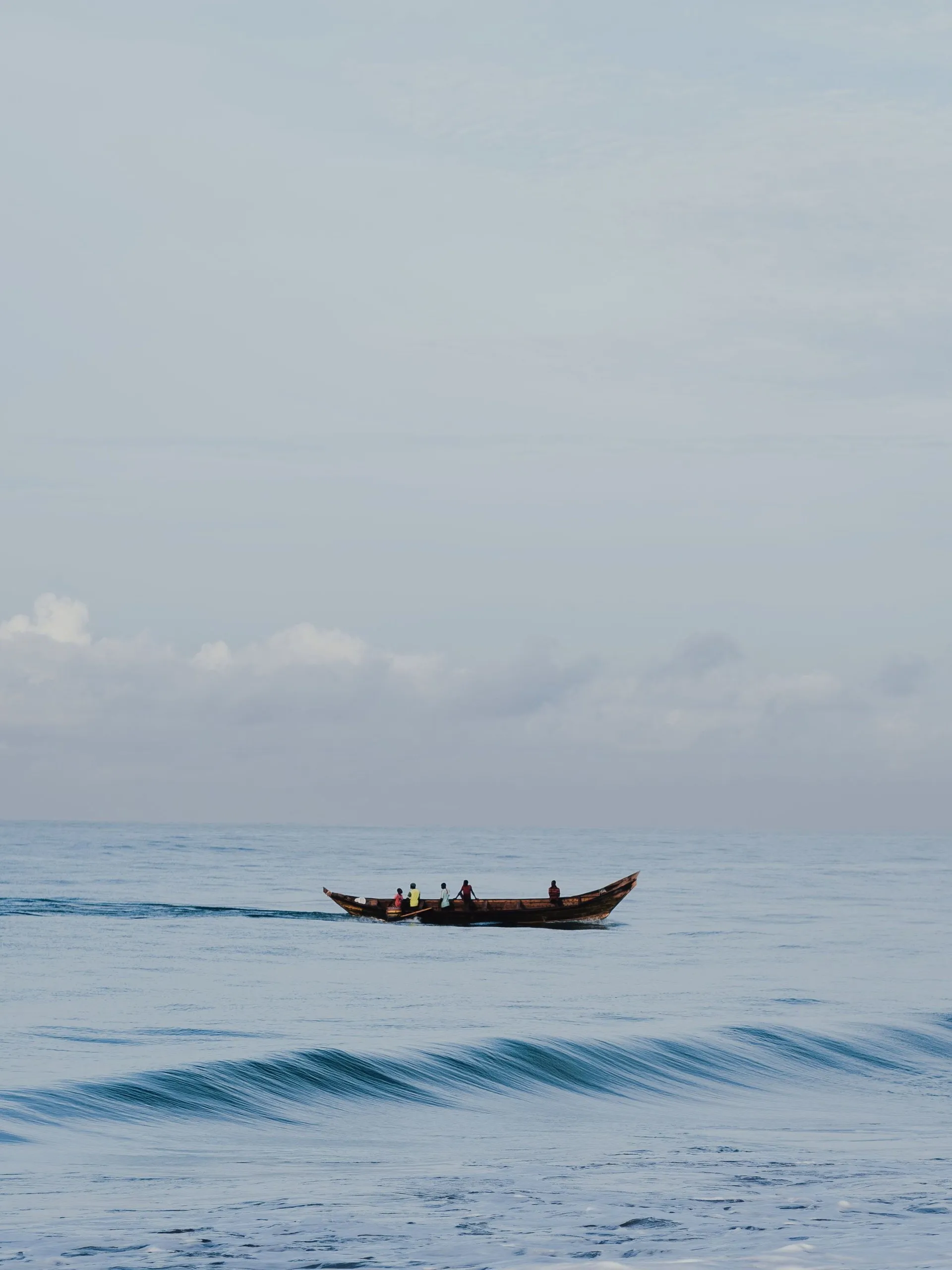
Pirogues measure between 6 and 12 metres long and can carry 4 to 12 people. Their flat bottom makes them stable even in waves. But their low freeboard, the gap between the waterline and the top of the hull, requires great familiarity with navigation. Passengers sit low, knees close to the water.
Crossing the barre: the daily wall of water
The most striking element of fishing in Grand-Popo is crossing the barre. This zone of massive breakers, where the ocean seems to repel intruders, is a wall of water that pirogues must cross each day to reach open water.
The barre forms where Atlantic waves meet the continental shelf, creating powerful rollers that can reach 3 to 4 metres high. The crossing is a ballet of muscle and precision. Rowers synchronise their movements with the rhythm of the waves, waiting for the exact moment to slip between two rollers. From the beach, the sound is enormous: a deep, percussive boom that you feel in your chest before you hear it with your ears.
One wrong move and the pirogue can capsize. The fishermen know this risk and accept it with a calm that is itself a kind of skill. Standing on the beach to watch a crossing is a complete experience, one that requires no further explanation.
The rowers do not fight the water. They read it. They wait for the brief, flat window between sets, then sprint. The pirogue crests the last roller and drops into calm water on the other side. It takes perhaps thirty seconds. It takes decades to learn.
What a 4am fishing outing actually looks like
For the more adventurous, joining a fishing outing with Grand-Popo's fishermen is possible and worth organising. The experience begins before dawn, around 4am. Departure is in darkness, by torchlight, amid the quiet energy of final preparations: nets checked, paddles counted, the bow touched briefly by the team leader before launch.
Crossing the barre in the half-light is an intense moment. The waves seem even higher in the dark, but the crew stays calm, each at their post. Once past the barre, the pirogue heads for the fishing grounds, guided entirely by the team leader's knowledge, no GPS, no chart, just memory and instinct.
The net is cast with careful precision. Then comes the wait. The sea is surprisingly quiet out there, far from the surf noise of the barre. The fishermen talk in low voices, share jokes, pass around a thermos of sweet tea. Hauling in the net is a collective effort that mobilises the whole team. Each catch is greeted with exclamations: satisfaction for the good pieces, laughter for the small fish.
The return is easier than the outward journey. The pirogue surfs the waves, carried by the current. Arriving on the beach is a festive moment, where families and sellers await news of the catch. This experience of fishing life is one of the most authentic ways to connect with Grand-Popo's coastal culture.
Hauling the nets from shore: join the human chain
If you do not go on board, the experience from the shore is just as vivid. Hauling the nets is a unique moment of social communion, and it is open to anyone who asks.
Once the net is cast offshore from a small pirogue, dozens of men line up on the beach to pull it back by brute force. The rope is thick and heavy, wet with salt, rough against the palms. You feel the resistance of the net, the weight of whatever is trapped inside, long before you see the first fish.
The work is carried by polyphonic songs that synchronise the effort. It is the heartbeat of Grand-Popo. The songs tell of the sea, the fish, village life: short phrases repeated and layered until they become something close to a chant. Sometimes the women join in from the shore, creating an improvised polyphony that carries out to sea.
The return of the net is a celebration. Bream, capitaine, bar, mullet, prawns, crabs writhe on the wet sand, silver and orange in the morning light. The sale happens on the spot, in the atmosphere of a short-lived, vibrant market. Prices are negotiated with smiles, watched by gulls waiting for their share.
Take your place in the human chain. It is the best way to break the ice and share a genuine moment of daily life with the fishermen.
Four fishing techniques still used today
Grand-Popo's fishermen use several techniques, each adapted to a specific species and season. These are not museum methods: each one is chosen daily based on conditions, catch targets and tidal timing.
The four main techniques in use today:
- Purse seining: the most widespread method. A long net, sometimes several hundred metres, is deployed in a circle around a school of fish. The fishermen then close the bottom of the net by pulling ropes, trapping the fish inside. This technique requires perfect coordination between the teams on board and those on the beach, and can take two to three hours from cast to haul.
- Gillnetting: a vertical net placed in the path of fish, with mesh sized to catch fish of a specific size and let smaller ones pass through. Used for inshore fishing, near rocks and reefs, where purse seining is impractical.
- Trolling: practised offshore, with artificial lures or natural bait trailed behind the moving pirogue. This technique targets large pelagic fish: tuna, wahoo, sailfish. It is the most solitary method and the one most appreciated by visiting anglers.
- River trapping: for freshwater species, fishing in the Mono River uses traps, specific nets and bottom lines. River fishermen have their own inherited techniques, developed in parallel to those of the sea and just as closely guarded.
When the pirogues return: beach market at 9am
The return of the pirogues is a daily ritual that draws attention on its own. From 9am, the first boats reappear on the horizon, dark shapes against the flat blue of the Atlantic. You can hear the paddles before you can make out the faces.
Families wait on the beach. Children run towards the pirogues to see the catch, crouching at the waterline to peer into the hull. Sellers, seated under parasols with basins and plastic trays at their feet, prepare their stalls. In the restaurants along the shore, cooks step out to watch: what arrives in the next hour will determine the day's menu.
The catch is sorted by species and size directly on the sand. The air smells of brine and wet scale. The best pieces, large capitaine or whole bar, go to restaurateurs and wholesalers. More modest fish are sold to locals for home cooking. Anything unsold by midday is smoked over coconut-husk fires or salted and laid out to dry on wooden frames.
Prices vary by species and season. Current approximate ranges to expect:
- Capitaine (Nile perch or similar): 3,000 to 8,000 FCFA (5 to 12 EUR) depending on size
- Bar (sea bass): 2,000 to 5,000 FCFA (3 to 8 EUR)
- Tray of prawns: around 2,000 FCFA (3 EUR)
Prices are negotiated in good humour, each party knowing the value of what changed hands.
Eating what you watched being caught
Absolute freshness is the real luxury of Grand-Popo. The fish you saw lifted from the net at 8am will be grilled over a wood fire for your lunch before noon. No cold chain, no packaging, no delay between sea and plate.
Head to Chez Paterne to taste the day's catch, prepared according to the Paterne family's traditional recipes. The fish is marinated with citrus and local spices, grilled slowly over hardwood embers, and served with attioke, alloco or sauteed leafy vegetables. The smoke clings to the wood tables. You eat in the shade of a corrugated roof with the sound of the surf twenty metres away.
Some restaurants will cook your own catch if you bring it from the beach. Buy the fish from the fisherman directly, carry it to the kitchen, and the chef prepares it for you in the style of your choice. It is an experience that removes every layer between the sea and the plate. Our guide to seafood in Grand-Popo gives you all the keys to enjoy this exceptional freshness.
How to book a fishing outing in Grand-Popo
To experience the complete artisanal fishing outing, booking in advance with a local guide or directly with the village fishermen is the right approach. Turning up on the beach at 4am without a prior arrangement is possible but leaves too much to chance.
Outings generally last 3 to 4 hours, departing before dawn. The price is negotiated on site, around 15,000 to 25,000 FCFA (23 to 38 EUR) per person, with equipment provided. The fish caught can be taken with you or left with the crew to sell at market.
A few practical points worth knowing before you go:
- Best season: November to March (dry season), when the sea is calmer and fish more abundant
- Rainy season (April to October): outings are possible but conditions are less predictable and the barre more aggressive
- What to bring: a light waterproof layer, closed shoes you do not mind soaking, and a headlamp for the pre-dawn departure
- Physical condition: no particular fitness required for the shore experience; the on-board outing involves sitting in a low hull for several hours and crossing the barre twice
The fishermen of Grand-Popo are not tourist guides by profession. They are workers who agree to share their morning when asked with respect. That small distinction changes the entire quality of the experience.
Plan Your Visit
Discover the magic of Grand-Popo with our curated local experiences.