




Grand-Popo is far more than a beach resort: it is a unique cultural crossroads where the ancestral traditions of the Xwla people meet influences from Europe and the Americas. Here, culture is not a tourist sideshow. It is alive, daily, tangible. From Vodun ceremonies to the Sobrado houses built by former slaves who returned from Brazil, from Egungun masks to the Zangbeto night guardians, every street tells a story. This guide invites you to discover the cultural soul of Grand-Popo.
Grand-Popo, cultural crossroads: a museum that breathes
Perched on Benin's Atlantic coast at the Togolese border, Grand-Popo has always been a place of passage and exchange. Portuguese navigators established trading posts here as early as the 16th century. Families of former slaves returning from Brazil brought Sobrado architecture and a distinctive Afro-Brazilian culture. The Xwla people, the city's founders, preserved their traditions while absorbing these outside influences.
This layering of influences makes Grand-Popo an open-air museum of West African history. But unlike a museum, everything is alive: ceremonies happen weekly, artisans work before your eyes, and the Zangbeto night guardians still patrol the streets after sunset. To understand the authentic Benin, Grand-Popo is an essential stop.
The town has several districts that reflect this cultural diversity. The historic quarter, around the market square, concentrates the Sobrado houses and colonial remnants. Along the beach, ecolodges and bars sit alongside traditional Xwla fishermen's homes. On the banks of the Mono River, life revolves around the water: pirogues moored, nets spread in the sun, women washing clothes while singing.
This diversity makes Grand-Popo an endless terrain for the curious traveler. Each season brings celebrations, rituals and shared moments. The complete guide to Grand-Popo offers an overview of the destination.
Vodun: a living religion, everywhere present
Vodun is the ancestral religion of southern Benin and Togo. Often misunderstood through Hollywood cliches of "voodoo", it is in reality a complex, structured spirituality based on the worship of natural forces and ancestors.
In Grand-Popo, Vodun permeates daily life. Ceremonies mark the calendar: baptisms, weddings, funerals, divinatory consultations. Every village has its Vodun convent, a sacred space where initiates receive the teachings of the deities.
The main deities honored in Grand-Popo include Mawu (the creator god), Lisa (the masculine principle), Dan (the rainbow serpent), Xevieso (god of thunder) and Sakpata (god of the earth). Each deity has its own priests, rituals and specific taboos.
Attending a Vodun ceremony is a powerful experience, provided you do so with respect. It is essential to ask a local guide about proper etiquette: appropriate dress (shoulders and knees covered), silence during rituals, and permission before taking photos. The ceremony is not a performance; it is a spiritual act. Participants, whether initiated or simple faithful, come to honor the deities, seek healing or give thanks for a granted favor.
The Vodun convent is closed to the uninitiated public. If you are invited to a public ceremony, consider it a privilege. Do not photograph without explicit permission, and follow the instructions given by the officiants. The most accessible ceremonies take place during the National Vodun Festival on January 10, when several villages hold open celebrations.
For more depth, read our complete guide on Vodun in Grand-Popo. You will find detailed information on local deities, sacred sites and dates of public ceremonies.
When ancestors walk the streets: the Egungun masks
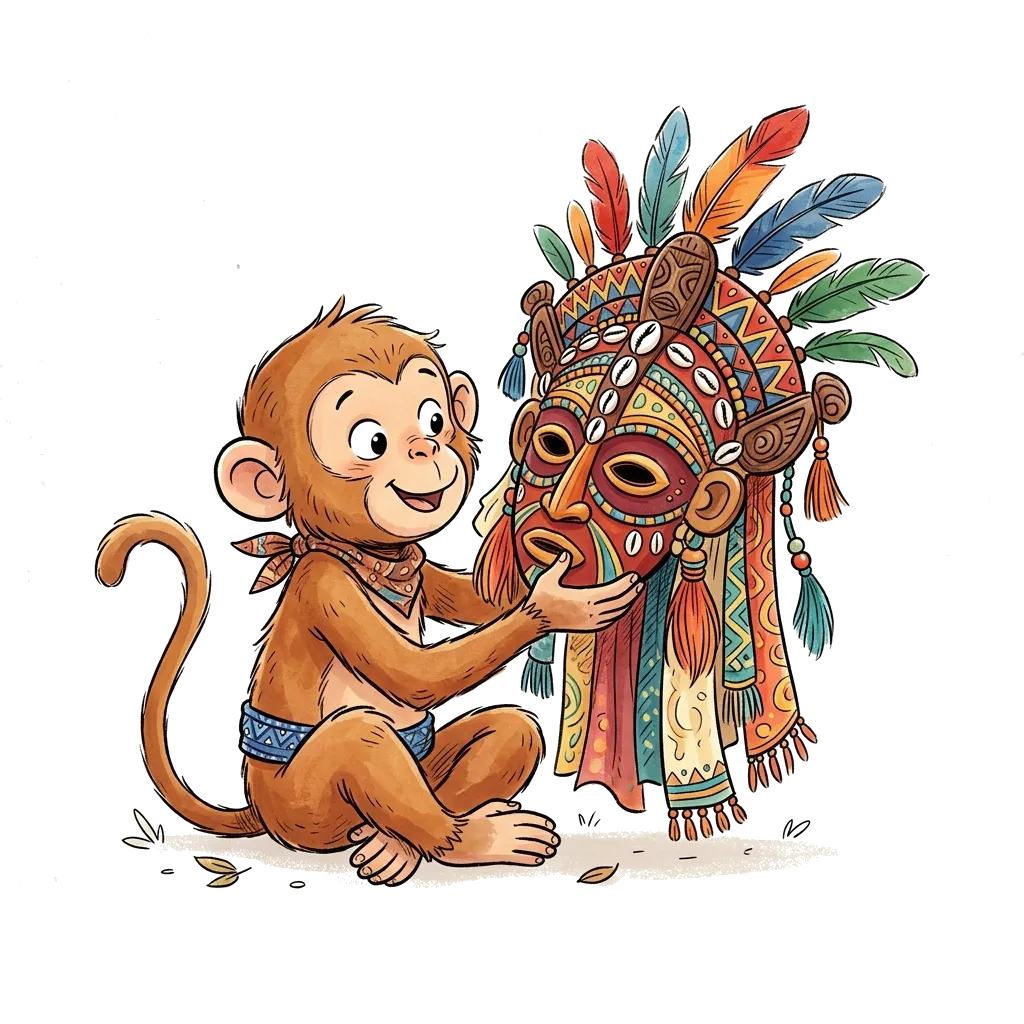
The Egungun are sacred masks that embody the spirits of ancestors returning among the living. This tradition, of Yoruba origin, is deeply rooted in Grand-Popo and the surrounding region.
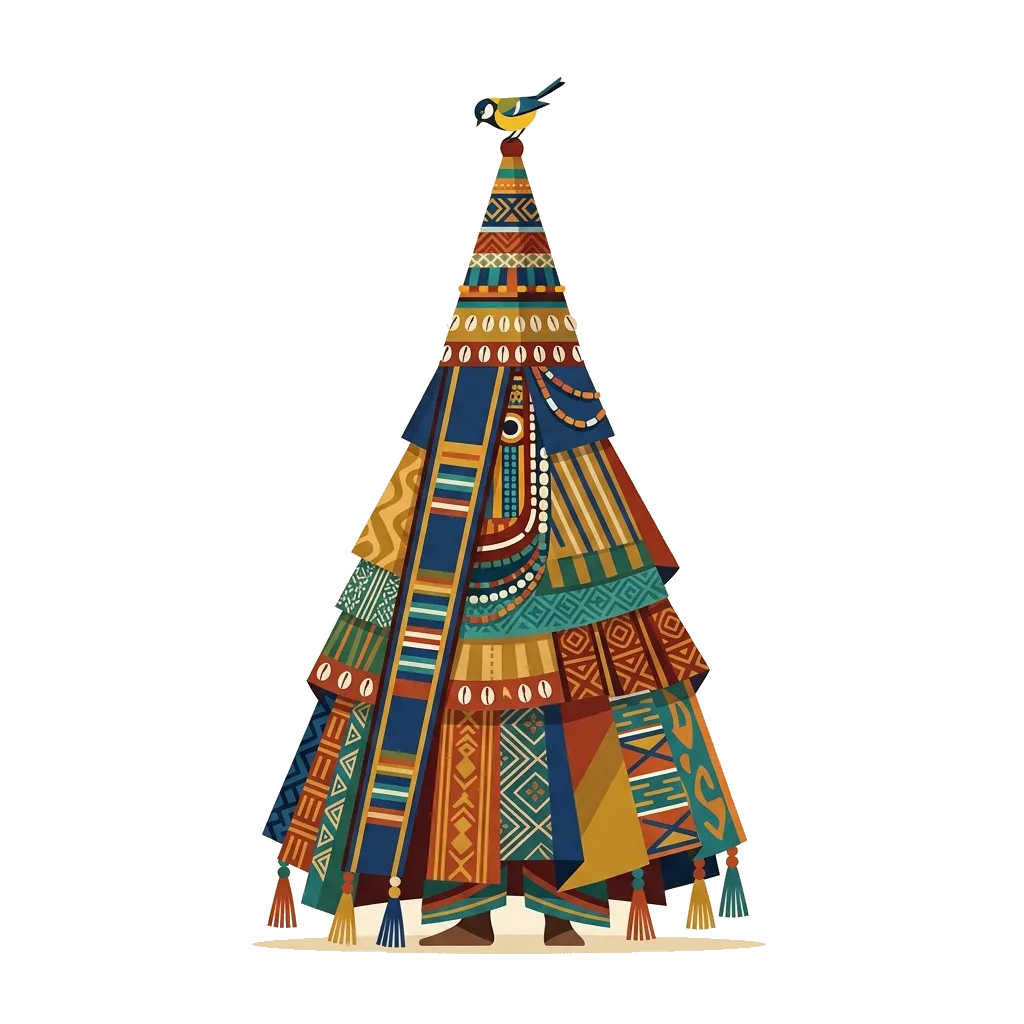
During Egungun ceremonies, mask wearers entirely covered in multicolored fabrics dance to the rhythm of drums, literally incarnating the ancestors. Their voices are altered through special vocal techniques that mimic the speech of the dead. The atmosphere is both solemn and vibrant. The air feels charged with something the uninitiated cannot name.
These ceremonies take place at specific times in the calendar: major funerals, annual festivals, or for particular spiritual needs of the community. Seeing an Egungun is considered a blessing, a direct connection with the invisible world.
It is important to understand that the Egungun are not circus acts for tourists. They are sacred manifestations that demand respect and dignity from spectators. The rules are strict: no photos without permission, no touching, no disrespectful behavior.
Our dedicated page explains everything about Egungun masks in Grand-Popo.
The best time to witness an Egungun ceremony is between November and March, during the dry season, when climatic conditions allow outdoor gatherings. Funerals of important personalities are also occasions for particularly impressive Egungun ceremonies. Ask your guide or accommodation for the calendar.
What the Zangbeto truly guards: the night guardians
The Zangbeto, literally "night guardians" in the Goun language, are a unique social and spiritual institution along Benin's coastal region. Their role is multi-faceted: they serve as traditional police, spiritual guardians and animators of village nightlife.
The Zangbeto appears at night, entirely covered in a costume of straw and raffia that makes him unrecognizable. He moves by dancing to the rhythm of drums, his spectral silhouette cutting through the darkness. His primary function is to protect the village against evil spirits, sorcerers and thieves.
Contrary to what the Zangbeto's mysterious appearance might suggest, his social role is very concrete: he arbitrates conflicts, ensures community rules are respected and provides nightly security. It is an institution both respected and feared.
Witnessing a Zangbeto appearance is one of the most memorable moments of a stay in Grand-Popo. To find out where and when to see them, consult our Zangbeto guide.
The spectacle is striking: the Zangbeto spins on itself at surprising speed, its straw silhouette seemingly defying gravity. The drums beat a hypnotic rhythm, and the audience participates with songs and encouragement. Yet behind this impressive performance lies a very real social role: the Zangbeto is also an arbiter, a peace judge and a guardian of the village's moral order.
Afro-Brazilian heritage: the round-trip journey
One of the most striking features of Grand-Popo is its Afro-Brazilian heritage, carried by the Agouda families. These descendants of former slaves who returned from Brazil in the 19th century left a deep mark on the city's architecture, cuisine and culture.
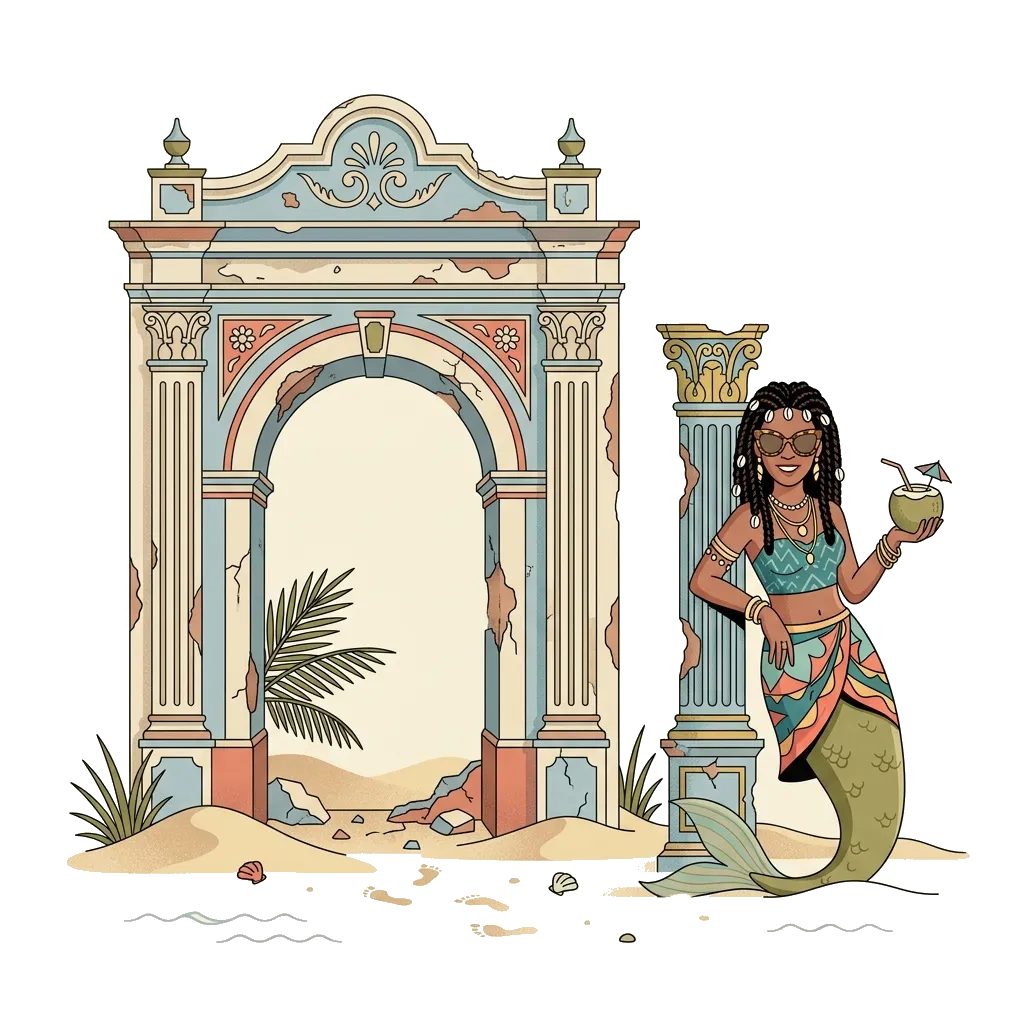
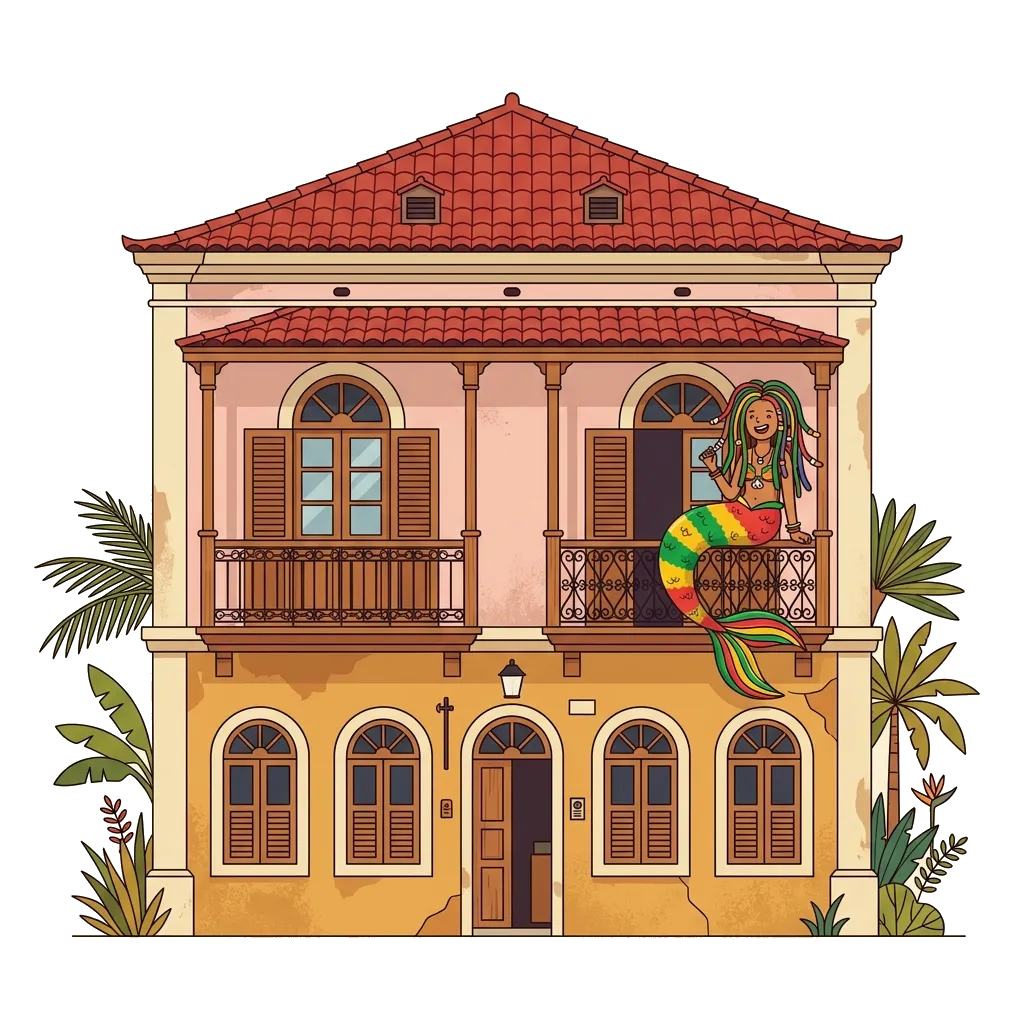
The Sobrado houses, with their colorful facades, wrought-iron balconies and high ceilings, are the most visible legacy of this community. Several of these historic buildings still stand, some restored (like Villa Karo), others reduced to ruins that coastal erosion threatens more each year.
Family names like De Souza, Silva, Carvalho and Santos are still borne by many Grand-Popo families, testifying to this transatlantic history. The local cuisine itself carries this influence: the use of palm oil, gari and tropical fruits recalls the culinary exchanges between Brazil and Benin.
To explore this unique heritage in detail, read our guide on Afro-Brazilian heritage in Grand-Popo.
The Xwla people: founders and keepers of memory
The Xwla are the founders and the soul of Grand-Popo. This people of fishermen and navigators settled on this coast several centuries ago, drawn by the fish-rich waters of the Mono River and the Atlantic Ocean.
Xwla culture is intimately tied to water and fishing. Their pirogues, carved from tree trunks, are a symbol of their identity. Fishing techniques pass from father to son, and sea excursions structure village life. Before the great seasonal fishing expeditions, Vodun priests bless the pirogues and nets in a ceremony that no fisherman would skip.
The Xwla language, threatened by the dominance of French and Fon, is now the focus of preservation efforts. Local initiatives, particularly through education and culture, are working to keep this ancestral language alive. Radio programs, children's tales, school booklets printed in Xwla. The language resists.
Meeting the Xwla communities means understanding the deep, respectful relationship this people maintains with the ocean. Their knowledge of currents, winds and fish is a precious wisdom that fascinates visitors.
To learn more, read our page on the Xwla people.
Historic architecture: walls that speak
Grand-Popo boasts remarkable architectural heritage that testifies to its eventful history. The ruins of Portuguese, German and French colonial trading posts are still visible along the coastline, some buildings dating from the 17th and 18th centuries. These structures, built in laterite stone and mud brick, bear the marks of the different regimes that succeeded one another.
The Portuguese trading post, built in the mid-17th century, was one of the first European establishments on the Slave Coast. Its thick walls, gun slits and L-shaped plan reflect a defensive architecture designed to withstand attacks. The Germans, present at the end of the 19th century, left several administrative buildings recognizable by their tiled roofs and arched windows. The French later added larger constructions, including the former colonial customs house with its white facade and columns.
The most emblematic building is Villa Karo, a former colonial residence beautifully restored and now home to a Finnish-African cultural center. Its high ceilings (over four meters) promote air circulation, its verandas protect the facades from the sun, and its stabilised earth walls, about 60 centimeters thick, keep interiors cool even in the hottest hours. The garden, planted with local species and fruit trees, is a green lung in the heart of town.
Beyond Villa Karo, several 19th-century Sobrado houses are worth the detour. These Afro-Brazilian dwellings are recognizable by their bright colors (ochre, sky blue, pale green), wrought-iron balconies and carved door frames. The De Souza house, though partially in ruins, still preserves its original glazed tiles imported from Brazil and its painted wooden shutters.
Sadly, coastal erosion poses a serious threat to this heritage. Each year, the sea advances, swallowing historic buildings. This urgency gives even more value to the surviving vestiges.
Our guide on colonial architecture in Grand-Popo offers a walking tour to discover these treasures before they disappear.
Crafts: hands that transmit
Grand-Popo's crafts reflect the region's cultural richness. Traditional weaving, wood carving and pottery are the most represented skills. Each piece tells a story and carries the signature of its creator.
Xwla weavers produce fabrics with traditional geometric patterns, dyed with natural colorants from iroko bark (deep brown), indigo leaves (midnight blue) and pomegranate bark (yellow ochre). The sound of the loom, the rhythmic clacking of the shuttle crossing the warp, is a familiar music in Xwla village courtyards. Handwoven cloths with symbolic motifs representing prosperity, fertility or protection are worn at ceremonies and weddings.
Wood carvers create masks, statuettes and utilitarian objects. The wood is sun-dried for several months before being worked. The carver first roughs out the piece with an axe, then shapes it with knives and gouges, before sanding with pumice stone and coating with palm oil to protect against insects. Traditional masks, representing forest spirits or ancestors, take several days to complete.
Potters shape jars and dishes using techniques unchanged for centuries. Sitting on the ground, they build pieces by coiling, smoothing the surface with a pebble before open-air firing. The feel of the wet clay, the slow rotation of the piece, the potter's silent concentration are all part of the show.
The best place to discover local crafts is the Grand-Popo market, where artisans sell their creations directly. For a guide to authentic souvenirs, see our page on Grand-Popo crafts.
Music and dance: the body's languages
Music and dance are at the heart of cultural life in Grand-Popo. Traditional rhythms accompany every stage of life: birth, initiation, marriage, funerals. Drums, balafons and rattles are the ruling instruments.
The talking drum, called tama or gankogui depending on tradition, occupies a central place. Its two faces, struck with a curved stick, produce modulated sounds that imitate the tones of the language. An experienced drummer can transmit messages over several hundred meters. The balafon, with its wooden keys suspended over calabashes, produces bright, crystalline notes that carry far into the village silence. Calabash rattles, covered with a net of beads, accompany women's songs during ceremonies. Together they form a complex polyphony where each instrument dialogues with the others.
Ceremonial dances, such as the Egungun dance or the Zangbeto choreographies, are powerful spiritual expressions. Every step, every gesture carries precise meaning. The circular movements of the Egungun evoke the cycle of life and death. The Zangbeto's leaps symbolize vigilance and protection. The Xwla fishermen's dance, performed after a good catch, mimics the gestures of casting nets and hauling pirogues onto the sand.
Grand-Popo also has a contemporary music scene. Local artists blend traditional Xwla rhythms with reggae, jazz and afrobeat. Lion Bar is the prime venue for live music, especially on weekends. Villa Karo regularly hosts concerts and outdoor performances in its garden. Ask your accommodation about events planned during your stay.
Culture in daily life: here, everything has a meaning
What makes Grand-Popo's culture so unique is that it is not staged for tourists. It is lived daily: the woman selling fish at the market wears the same patterns you will see at a ceremony. The children playing on the beach grow up with stories of the Zangbeto and the wisdom of Vodun.
An ordinary morning in Grand-Popo: the sound of drums in a convent, the smell of incense near a Legba altar, the clacking of a loom in a courtyard, the song of fishermen pulling their nets. This is not a cultural program. It is simply a day.
For the visitor, the invitation is simple: open your eyes, listen, and let yourself be carried by the rhythm of Grand-Popo. Culture is not to be visited. It is to be lived.
Ready to experience Grand-Popo's culture?
The cultural richness of Grand-Popo is both a privilege and a responsibility for the visitor. By coming, you participate in the preservation of these living traditions. Every ceremony you respectfully attend, every artisan you buy from, every traditional dish you savor is a gesture of support for this vibrant culture.
To organize your trip and book your cultural experiences, contact us on WhatsApp. Our local guides will be happy to accompany you on this discovery.
Plan Your Visit
Discover the magic of Grand-Popo with our curated local experiences.