






Ancestor ceremonies are among the most sacred spiritual manifestations in Grand-Popo. When drums resound and costumes emerge from the shadows, the living and the dead meet in a dialogue that spans centuries. Grand-Popo ancestor ceremonies embody the living memory of a people who honour their ancestors with fervour and respect.
To understand the context of these practices, dive into our guide to Grand-Popo's culture and heritage. And for an overview of the region's celebrations, see our dedicated page on events and festivals in Grand-Popo.
When the spirits return: the meaning of ancestor ceremonies
Ancestor ceremonies refer to all rituals during which the spirits of ancestors (Egungun) or spiritual guardians (Zangbeto) manifest among the living. These traditions date back several centuries and draw their roots from Yoruba culture for Egungun, and Xwla (Pedah) culture for Zangbeto.
What distinguishes these ceremonies from simple folkloric performances is their sacred dimension. For the communities that practise them, the spirits are truly present during the rituals. The costumes are not disguises but spiritual receptacles. The dances are not artistic performances but manifestations of the invisible. This distinction matters enormously: an Egungun ceremony is not a re-enactment of something that once happened, but the thing itself happening now, in front of you.
Ceremonies follow a strict protocol, set by families and convents (practitioner communities). They do not occur on fixed dates but according to seasonal cycles, family events or specific community needs. A death in the family may prompt an ancestor return three months later or three years later, depending on what the divination system prescribes and what the family can organise. The calendar belongs entirely to tradition, not to tourism.
What you feel when you stand at the edge of a ceremony circle is difficult to describe. The air is different. The light on the surrounding walls catches the spinning fabric in ways that make the eye question what it sees. Children in the crowd press closer to their mothers without being asked.
Visitors must approach these ceremonies with humility and respect. This is not a tourist show: it is the expression of a living faith, as legitimate as any religious practice in the world.
The smell of burning palm wood, incense and damp earth is part of the ceremony as much as the drumming itself. Senses you rarely use together are suddenly speaking to each other. Standing there, the rational urge to document and analyse loosens. Something older takes its place.
Egungun, spirits of the ancestors
Egungun are the "returning spirits" par excellence: the spirits of ancestors who come back to visit the world of the living. This tradition, inherited from the Yoruba ancestor cult, is deeply rooted in Grand-Popo, where it has been passed down through generations.
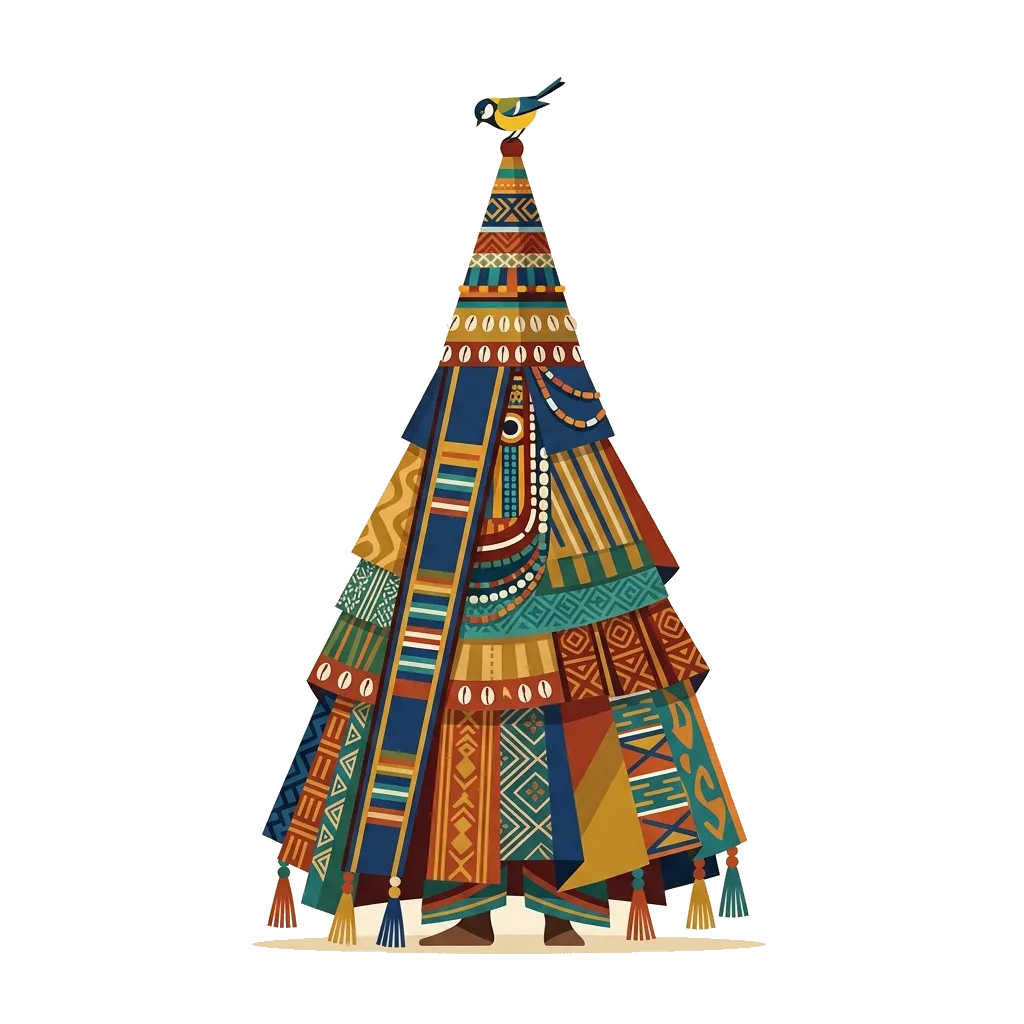
The Egungun costume is a textile work of art. Composed of multiple layers of colourful fabric (velvet, brocade, printed cotton), embellished with cowries, mirrors, beads and amulets, it completely covers the wearer. The face is hidden by a mask or thick veil: when the initiate puts on the costume, they cease to be an individual and become the very incarnation of the ancestor.
Each costume is unique and belongs to a specific family. It is passed down through generations, enriched over time. The patterns and colours carry meaning: red evokes power and war, white purity and spiritual connection, black mystery and transition. The oldest costumes can hold more than a century of family history layered into their fabric, each generation adding a panel or a bead to mark their passing.
During the ceremony, the Egungun perform a sacred choreography, spinning and moving to the rhythm of drums. Their voice, modified by an internal vocal device, seems to come from beyond the grave. They bless families, ward off evil spirits and remind the living of their responsibilities towards the ancestors. Occasionally they pause beside a particular person in the crowd and speak directly to them — a moment so intimate that witnesses often step back instinctively, feeling the boundary between worlds grow thin.
The drumming that accompanies an Egungun appearance is not background music. Different rhythmic patterns signal different phases of the ritual: the arrival, the blessing, the warning, the departure. Experienced community members can read these patterns the way others read text. For the first-time visitor, the sound alone — dense, polyrhythmic, felt in the chest cavity — carries something that transcends language.
Some Egungun are known for their humour: they tease elders, mimic characters from the village's past, or comment on present-day situations in cryptic Yoruba verses. The crowd laughs and weeps within the same minute. Joy and solemnity are not opposites here. They are two faces of the same encounter with the ancestors.
To explore this subject, read our article on Egungun masks in Grand-Popo.
Zangbeto, guardians of the night
Zangbeto are a traditional institution unique to the world. Their name means "guardians of the night" in the Xwla language. Their role is both spiritual and social: they protect villages from malevolent spirits and exercise a night-police function, ensuring community rules are respected.
The Zangbeto costume is radically different from that of the Egungun. It is made of raffia, dried palm leaves and straw, assembled into an imposing volume that transforms the wearer into a moving mass several metres high. The silhouette is totemic, almost animal. In the firelight of a ceremony night, the sheer mass of the costume generates a presence that makes rational explanations feel inadequate.
Zangbeto ceremonies are spectacular. The guardians perform a powerful, whirling dance, spinning at surprising speed. Sometimes the costume seems to move alone in the night, without visible wearer. Initiates possess body techniques that defy understanding: jumps, rotations, fast runs despite the costume's weight. Village elders will tell you this is not technique — it is the guardian spirit itself that moves.
The smell of a Zangbeto ceremony is particular: dried palm leaves warmed by exertion, something resinous carried on the smoke from nearby fires, and underneath it all the salt of the Atlantic carried on the breeze. Senses combine in ways that waking life rarely offers. You may find yourself holding very still.
Unlike the Egungun, Zangbeto do not incarnate specific ancestors. They are generic guardian spirits, tied to the land and community. Their authority is recognised by all, and no one contests their night-police power. A Zangbeto appearance in a neighbourhood that has experienced a dispute is understood as both a warning and a resolution.
Before a Zangbeto emerges, the neighbourhood changes. Conversations lower to murmurs. Children are pulled indoors. The drums shift to a slower, more deliberate pattern. Even if you do not know what is coming, something in the air makes you wait. Then the costume rounds the corner, and the crowd parts like water.
Our dedicated page on Zangbeto in Grand-Popo explores in detail the history and practices of this institution.
Ceremony calendar
Ancestor ceremonies do not follow a tourist calendar. Their dates are set by customary authorities and family heads. Here are the general periods:
November to March (dry season). This is the peak season for Egungun ceremonies. The dry climate favours outdoor gatherings. Families organise ancestor returns between agricultural cycles. The highest concentration is in December-January, around the Vodun Festival on January 10.
April to June. Ceremonies become rarer. Some Zangbeto appearances may occur for specific community needs (conflicts, purification, protection). Egungun are less present.
July to October (rainy season). Ceremonies are more spaced out. Zangbeto remain active, especially at night. Egungun mainly appear on major occasions.
Precise dates are rarely known more than two weeks in advance. This is not evasiveness — it reflects the nature of the tradition itself. The consultation of the divination system, family consensus, the preparation of costumes, the availability of drummers: all must align before a date is set. No ceremony committee meets in January to plan the following December.
To maximise your chances of attending a ceremony, plan your stay between December and February and contact our team on arrival. We have privileged contacts with families and convents who can inform you of upcoming ceremonies.
Planning a stay of at least one full week is strongly recommended. Two weeks is better. The first days often pass without ceremony. Then, on a Thursday evening with no advance warning, word travels through the neighbourhood: tonight there is a ceremony. That is how these things work. Patience is not a virtue here — it is a prerequisite.
See our Grand-Popo cultural calendar to identify the most favourable periods.
Where the spirits come home: ceremony locations
Ancestor ceremonies take place in different locations around Grand-Popo:
In family compounds. Egungun ceremonies often occur in the courtyard of the family organising the ancestor's return. The space is prepared, benches are arranged for guests, an altar is set up with offerings. Access is restricted to invitees and community members. The intimacy of these settings — perhaps forty people gathered in a sandy courtyard, hurricane lamps throwing orange light on whitewashed walls — is something the larger public ceremonies cannot replicate.
On public squares. Major ceremonies, especially for the Nonvitcha Festival or January 10, take place on central squares and main streets. They are open to all.
Around Vodun convents. Convents (initiation training centres) are major sites for ceremonies. Each convent has its own calendar and rituals. Zangbeto appearances generally start from the convent to patrol the neighbourhood streets.
At night, in the streets. Zangbeto patrol at night. Chances of encountering them are higher in the dry season and during festive periods. Impromptu appearances are frequent. Hearing the crowd shift before you see the costume, knowing the Zangbeto is close, is part of the experience that no schedule can provide.
To attend a ceremony, the best way is to be introduced by a local guide who knows the families and convents. Never go to a ceremony site without being invited. Contact our team to facilitate your access in the best conditions of mutual respect.
Etiquette and respect
Attending an ancestor ceremony is a privilege that demands irreproachable behaviour. The following rules are not suggestions — they reflect expectations that the community holds firmly, and breaking them can affect the entire ceremony.
Ask permission. Before attending a ceremony, always ask permission. A local guide can introduce you and explain your presence to the organisers. Never impose yourself.
Dress respectfully. No short or overly casual clothing. White is recommended for Vodun ceremonies. Avoid all black. Cover your shoulders and legs. Arriving in white communicates something — it signals to the community that the visitor has done their homework and approaches the occasion with seriousness.
Stay at a distance. Do not position yourself in front of participants. Observe from the periphery of the circle. Do not cross the ceremonial space during the ritual.
Do not touch the costumes. Egungun and Zangbeto costumes are sacred. Touching them is a serious offense. Keep a respectful distance.
Speak softly. Ceremonies are moments of meditation and spiritual connection. Avoid loud conversations, laughter, phone calls.
Do not consume alcohol during the ceremony. Do not smoke near the place of worship.
Do not bargain with the sacred. Offerings are free and voluntary. Ceremonial artefacts are not souvenirs to buy.
Small offerings — kola nuts, a few coins placed discreetly near the altar — are a meaningful gesture. They communicate that you understand your presence has value, and that you wish to contribute to the ceremony rather than simply extract from it. Ask your guide how to give appropriately for the specific family you are visiting.
Photographing ceremonies
Photography is the most delicate aspect of ancestor ceremonies. Rules vary by family, convent and type of ceremony:
Never photograph without explicit authorisation. Before taking out your camera, ask permission from the organisers. Once authorised, respect the limits set (certain moments are forbidden, certain angles are reserved).
No flash. Artificial light is disruptive during rituals. Use a fast lens and raise the ISO.
Respect privacy. Do not photograph participants without their consent. Do not take close-ups of people in trance or prayer.
No video without agreement. Video is often more sensitive than photography. Families fear images being shared out of context. A recording that strips a ceremony of its surrounding silence, its smells, its duration — the community knows this can mislead, and they are right to protect against it.
Share your photos. If you were authorised to photograph, offer the pictures to the participants. It is an appreciated gesture that strengthens trust.
Consider leaving the camera behind for your first ceremony. The act of watching, with both hands free and full attention, changes what you see. The frame you spend time finding often blocks the feeling you came for. Come back a second time with the camera, once you know what matters.
The golden rule: if you are asked to put away your device, obey without discussion. Rules can change during a ceremony. Humility and respect are the only acceptable behaviours.
FAQ -- Ancestor ceremonies in Grand-Popo
Are ceremonies open to tourists? Yes, in most cases, provided you respect the rules and ask permission. A local guide is strongly recommended.
When can I see Egungun? Mainly November to March, peaking in December-January. Exact dates are set by families.
Are Egungun and Zangbeto dangerous? No, for respectful spectators. They embody protective spirits. Danger would come from disrespectful behaviour towards tradition.
Can I wear a costume or participate? No. Costumes are reserved for initiates. Active participation is impossible for non-initiates. Your role is that of a respectful observer.
Plan Your Visit
Discover the magic of Grand-Popo with our curated local experiences.