









The local cuisine of Grand-Popo is the most authentic expression of Beninese culture by the Atlantic. Between the Mono River and the ocean, ingredients from land and sea come together in dishes prepared with recipes passed down through generations. Every bite tells the story of a generous terroir and a people who know how to host.
Discovering Grand-Popo local cuisine means immersing yourself in a universe of flavors where freshness of ingredients comes first, spices are used with precision, and sharing is the golden rule. From dried shrimp sauces to fermented corn pastes, from grilled fish to sauteed vegetables, every dish is a celebration.
For an overview of Grand-Popo's table, start with our food and drink guide.
Flavors that carry the history of a coastline
What makes Grand-Popo's cuisine unique is the meeting of two worlds: the ocean and lagoon on one side, the land on the other. Fishermen bring in fish, crabs, lobsters and shrimp from the open sea. Women harvest artisanal salt from the lagoon salt pans. Farmers grow cassava, corn, yams, leafy greens and tropical fruits in the palm groves.
Spices play an essential role. Fresh chili, ginger, garlic, onion, stock cubes (a staple of West African cooking) and local spices create marinades and sauces that vary from family to family. Preparation secrets are passed from mother to daughter, and each cook adds her personal touch. Open a pot of simmering sauce on any Grand-Popo afternoon and the smell alone tells you where you are: smoke, palm oil and pepper rising together in the heat.
Beninese cuisine is generous by nature. Portions are abundant, hosts insist you take more, and refusing would be a slight. A meal is never complete without a thick sauce, a protein (fish, shrimp, crab or poultry) and a starch that absorbs the flavors. You eat slowly. The conversation is part of the recipe.
Drinks complete the picture. Sodabi, artisanal distilled palm spirit, is the traditional accompaniment to fish dishes. Fresh palm wine, bissap (hibiscus infusion) and tropical fruit juices are the non-alcoholic alternatives.
To discover local drinks, check our guide on Grand-Popo sodabi.
Traditional dishes you must know before you sit down
Grand-Popo's cuisine rests on a few fundamental preparations, adapted according to available produce.
Pastes (akassa, red paste) form the base of traditional meals. Made from fermented corn flour or cassava flour, they are cooked until firm and smooth. They are eaten with the fingers: take a small piece, roll it into a ball, dip it in sauce. This gesture, simple as it seems, is an art learned from childhood. Watch a local do it and you will see years of muscle memory in a single motion. The paste itself is mild and faintly sour, a steady backdrop that lets the sauce speak.
Sauces are the heart of Beninese cuisine. Tomato sauce with smoked fish, okra sauce, thick peanut sauce, baobab leaf sauce: each has its texture, color and personality. A good okra sauce should coat the back of a spoon and pull into silky threads when lifted. Sauces are prepared with fresh market ingredients and simmered for a long time to develop all their flavors. Rushing a sauce is the one mistake that no amount of spice can fix.
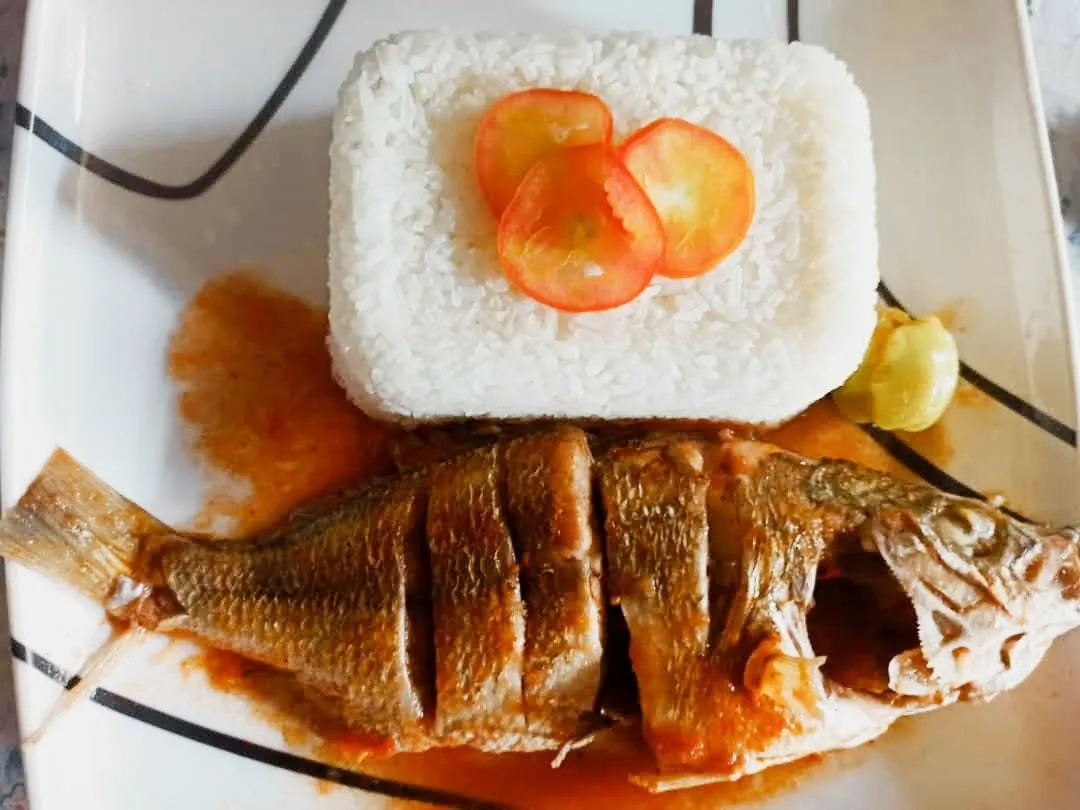
Fish and shellfish are prepared in many ways: grilled over wood fire (grilled fish), fried, in sauce (fish in tomato sauce), in soup (ginger fish soup) or dried (smoked fish, used as a condiment in sauces).
Vegetables accompany almost every dish. Okra, African eggplants, cassava leaves, sweet potato leaves, cabbage, carrots and green beans are cooked in sauce or sauteed in palm oil.
Traditional dishes are prepared daily at markets and in Grand-Popo homes. Visitors are welcome to taste and learn.
Gba na, the deep sauce that smells of the sea
Gba na is one of the most emblematic dishes of Grand-Popo's cuisine. Its name means "dried shrimp sauce" in the Xwla language, and that is exactly what it is: a thick sauce made from pounded dried shrimp, fresh tomato, chili and palm oil.
The preparation of gba na is a ritual. The dried shrimp are first pounded in a wooden mortar until a fine powder is obtained. The smell at this stage is intense, concentrated, almost meaty. Fresh tomatoes are blended with chili and onion. The whole mixture is cooked for a long time in red palm oil, until the sauce thickens and develops powerful aromas that fill the entire kitchen.
Gba na is served with corn paste (akassa) or white rice. It can also accompany grilled fish or sauteed shrimp. Its texture is creamy and clinging, its flavor deep and slightly smoky from the dried shrimp, with a hint of chili that warms the palate long after the last spoonful. The umami depth is unlike anything from a stock cube: richer, more complex, with a briny mineral note underneath.
Each family has its recipe: some add secret spices (clove, nutmeg, black pepper), others incorporate vegetables (okra, eggplant) to thicken the sauce. Gba na is an everyday dish but also a festive food, served on special occasions and at ceremonies where sharing food becomes a ritual of community.
It can be found in maquis and beach restaurants for about 2,000 to 3,000 FCFA (3 to 5 EUR) per dish, served with corn paste or rice. Market women also offer takeaway portions, prepared the day before, whose flavors have deepened and mellowed overnight.
Kplala, the fermented ball you break together
Kplala is another specialty of Grand-Popo's cuisine. It is a fermented corn paste, wrapped in banana leaves and steamed. The result is a dense ball, with a firm, chewy texture and a slightly tangy taste characteristic of fermentation. Unwrap it and you smell the banana leaf first, then the sour corn underneath. That layered unfolding of aromas is part of the pleasure.
Kplala is made from corn flour mixed with warm water, left to ferment for twenty-four to forty-eight hours. The paste is then seasoned with salt and sometimes chili, then shaped into balls wrapped in banana leaves. Steaming takes about an hour. The banana leaves seal in the moisture and impart a faint vegetal perfume that no other cooking method can replicate.
Kplala is eaten hot, accompanied by a tomato or peanut sauce. It is often served with smoked fish or crumbled dried shrimp on top. It can also be fried in slices, which gives it a crispy, golden exterior and a soft, yielding interior.
This dish is traditionally prepared for festivals and ceremonies. It symbolizes unity and sharing: kplala is not eaten alone, but in a group, each person taking a piece of the common ball. That act of breaking a shared food together is as important as the taste itself.
At the Grand-Popo market, kplala is sold in portions of 500 to 1,000 FCFA (0.76 to 1.50 EUR) depending on size. The women vendors offer it with sauce prepared on the spot, in large pots placed directly on the ground.
Akassa, the quiet anchor of every Beninese table
Akassa (or red paste) is the most widespread basic paste in Grand-Popo's cuisine. Made from fermented corn flour, it is cooked in boiling water until it reaches a thick and smooth consistency. Taste it alone and it is mild, faintly sour. Against a bold sauce, it becomes the quiet partner that makes the whole dish work.
The red color of akassa comes from the addition of fresh tomato and palm oil during cooking. This distinguishes it from white paste (simple akassa), prepared without tomato. Red paste is more fragrant, richer, and considered more festive. Its color varies from burnt orange to deep brick red depending on the quality of the palm oil used.
Preparing akassa requires skill and patience. The corn flour is first sifted, then mixed with cold water to avoid lumps. The mixture is poured into boiling water and stirred vigorously with a wooden spatula for about twenty minutes without stopping. Pureed fresh tomato and palm oil are added at the end of cooking. A good akassa should pull cleanly away from the pot. If it sticks, the flour was not fermented long enough or the fire was too high.
Akassa ideally accompanies thick sauces (okra, peanut, tomato with fish) and dishes in sauce. It is the privileged companion of gba na and fish in sauce. Its smooth texture and slightly acidic taste perfectly balance the powerful flavors of Beninese sauces.
Vegetables and spices, the everyday palette
Vegetables and spices are the pillars of Grand-Popo's cuisine. The market offers an abundance of fresh produce that varies with the seasons.
The following ingredients appear in almost every dish:
- Cassava leaves (saka-saka), pounded and cooked for a long time in palm oil, yielding a dark, unctuous preparation with a slightly bitter edge
- African eggplant (gboma), smaller and more bitter than its European cousin, which deepens and rounds out every sauce it enters
- Fresh okra, sliced thin and added late, giving sauces their characteristic silky, pulling texture
- Sweet potato leaves and baobab leaves (kinkeliba), used in lighter sauces during the rainy season when other greens are scarce
Spices are preferably used fresh. Fresh chili (several varieties, from mild to very hot), ginger, garlic, onion and shallot are the daily basics. Clove, nutmeg, black pepper and thyme appear in more elaborate dishes. African parsley, local basil and fresh mint perfume marinades and finish sauces. Stock cubes, ubiquitous throughout West Africa, are used in moderation by good cooks who prefer to build flavor through time rather than shortcuts.
Palm oil, the orange heart that colors every dish
Palm oil is the fundamental ingredient of Grand-Popo's cuisine. It is produced artisanally from the fruits of the oil palm, which grows abundantly in the region.
Traditional palm oil production is a long and physical process. The fruits are first steamed, then pounded in a mortar to separate the pulp from the kernel. The pulp is pressed to extract the crude oil, which is then filtered and boiled to purify it. The result is a deep amber liquid that smells of roasted nuts and caramel, nothing like the pale refined product sold in supermarkets elsewhere.
Red palm oil, unrefined, is the most used. It has a dark orange color, a characteristic flavor (slightly nutty, faintly fruity) and a creamy texture at room temperature. It is rich in carotene and vitamins A and E. Its high smoke point makes it ideal for frying and long cooking without burning. Pour it into a hot pan and the color deepens to a glowing rust, releasing a toasty warmth that fills the kitchen in seconds.
Palm oil is used in almost all Beninese dishes: for frying doughnuts, sauteing vegetables, cooking sauces, preparing pastes. It gives dishes their characteristic deep orange color and a warmth of flavor that no substitute can reproduce.
Grand-Popo's cooks prefer artisanal palm oil, produced locally, to refined industrial oil. They will tell you the difference in taste is incomparable. They are right.
Culinary heritage: three traditions in one pot
Grand-Popo's cuisine is the heir to several traditions that have blended over the centuries, each leaving something behind in the pot.
Xwla tradition is the base. Fishing techniques, salt harvesting, sauce preparation and corn pastes are those of the lagoon peoples, adapted to an environment where water and land meet continuously.
Afro-Brazilian influences were brought by the Agoudas, former enslaved people who returned from Brazil in the 19th century. They are found in the use of palm oil, coconut and certain frying techniques that are otherwise unusual in the region.
Colonial contributions introduced bread, imported rice and industrial drinks. They did not replace traditional cuisine, but they added layers to the everyday table that remain visible today.
Today, Grand-Popo's local cuisine is experiencing renewed interest. Young chefs reinterpret ancestral recipes with modern techniques while respecting the spirit of each dish. Restaurants value local produce and short supply chains. Cooking classes attract travelers who want to learn to prepare these dishes at home. Preserving traditional cuisine means preserving a precious intangible heritage: the women who pass on their recipes, the fishermen who supply the produce, the cooks who innovate without betraying are all its keepers.
FAQ
Which traditional dishes should I try in Grand-Popo? Gba na (dried shrimp sauce), kplala (steamed fermented corn paste) and akassa (red paste) are the unmissable dishes.
Where to try local cuisine in Grand-Popo? In maquis and beach restaurants, at locals' homes by reservation, or at the Grand-Popo market.
How much does a traditional dish cost? Between 2,000 and 5,000 FCFA (3 to 8 EUR) depending on the dish and location.
Can I learn to cook local dishes? Yes, several local cooks offer cooking classes. Contact us to arrange a workshop.
Is Beninese cuisine spicy? Chili is present but the amount varies. Cooks adapt to their guests' palates.
What is the best season for local cuisine? All year round. The produce varies with the seasons, renewing the dishes with each visit.
Plan Your Visit
Discover the magic of Grand-Popo with our curated local experiences.