



Dawn on January 10
My alarm goes off at 5:30am. It is still pitch dark over Grand-Popo, but I can already hear the drums. Distant at first, muffled by distance and the sound of the waves. Then they draw closer, intensify, until they fill the whole space. It is not a rhythm I know. It is deep, insistent, like a heartbeat coming from the earth itself. Today is January 10. Today, Benin celebrates the national Vodun Festival, and Grand-Popo is one of its epicentres.
I get up and put on the white clothes I prepared the night before. White for purity, I was told. White to make oneself available to the spirits. Outside, the morning mist rises gently over the ocean. The first rays of sunlight tint the horizon pink. The day promises to be beautiful, and I sense that this January 10 will remain etched in my memory.
Before going out, I reread the notes I took on the rules of conduct. Do not photograph without permission. Do not touch initiates in trance. Speak softly. Listen more than watch. I am ready, or so I believe.
To understand the deeper meaning of this day, I had read our guide to Vodun in Grand-Popo and the article on the Vodun Festival of January 10. But nothing had prepared me for what I was about to experience. Reading about Vodun is like reading about swimming. The water is the part that cannot be described.
The first drums
I walk towards the town centre. The streets are already lively. Entire families, dressed in white, converge on the same point. Children run, adults carry offerings: kola nuts, chickens, palm oil, sodabi. The smell of incense floats in the air, mixing with the scent of dew-wet earth and the faint salt of the Atlantic two hundred metres to the south.
The drums are now very close. I feel them in my chest before I truly hear them. They are everywhere at once: ahead, behind, to the sides. Each Vodun convent has its own percussion ensemble, and all play at once, creating a complex, intoxicating polyphony. Different rhythms layer over each other without collision. It takes a few minutes to understand that what sounds like chaos is in fact a highly organised conversation between groups.
I reach the market square. The crowd is dense but silent in its movement. Faces are meditative. Some have closed eyes, swayed by the rhythms. Others sing softly, words I do not understand but whose melancholy touches me.
The Vodun convents are lined up around the square. Each has its altar, its symbols, its colours. I recognise the red and white cloth of Legba, the green and yellow of Sakpata, the blue of Hevioso. The priests, the vodunsi, prepare the ceremonies with a concentration that commands respect. One man in his seventies arranges small objects on a cloth with the unhurried precision of someone who has done this ten thousand times, and who knows exactly what each placement means.
The square smells of palm oil and burning wood and something sweeter beneath it all — the incense that has been lit since before anyone arrived. The ground near the altars is still damp where libations were poured at first light. I notice this without quite knowing why. Everything feels meaningful.
The procession
Around 8am, the procession begins. The priests lead, followed by initiates, then the faithful. I let myself be carried by the flow. We walk through Grand-Popo's streets to the slow rhythm of the drums. Songs rise, answered by the crowd in chorus.
At each crossroads, the procession stops. Libations are poured, prayers spoken. An old priest, face marked by years, traces patterns on the ground with corn flour and sacred water. He invokes the ancestors, asks their protection for the community, for the year ahead. The patterns he draws are geometric and deliberate. I am told later that each shape names a different ancestor, and that only those trained to read them can identify who is being addressed.
I am struck by the fervour emanating from every gesture. Nothing is mechanical or habitual. Each prayer is lived with an intensity that gives me goosebumps. I am not a believer, but something is happening inside me. A door half-opens.
The procession heads towards the beach. The ocean is a central element of Vodun: it is both a source of life, a border with the beyond, and a dwelling of powerful deities. Arriving at the water's edge, the cortege forms a semicircle facing the waves. The drumming shifts — a different pattern for the ocean, lower and more patient, as if speaking to something that is not in a hurry.
At the water's edge, the tide is coming in slowly. Nobody has planned it, but the ceremony and the sea seem to arrive together. White fabric against grey water. The sound of the drums changes when we reach the shore — flatter, more resonant, less enclosed. I am close enough to see the priest's hands. They do not shake.
The officiants
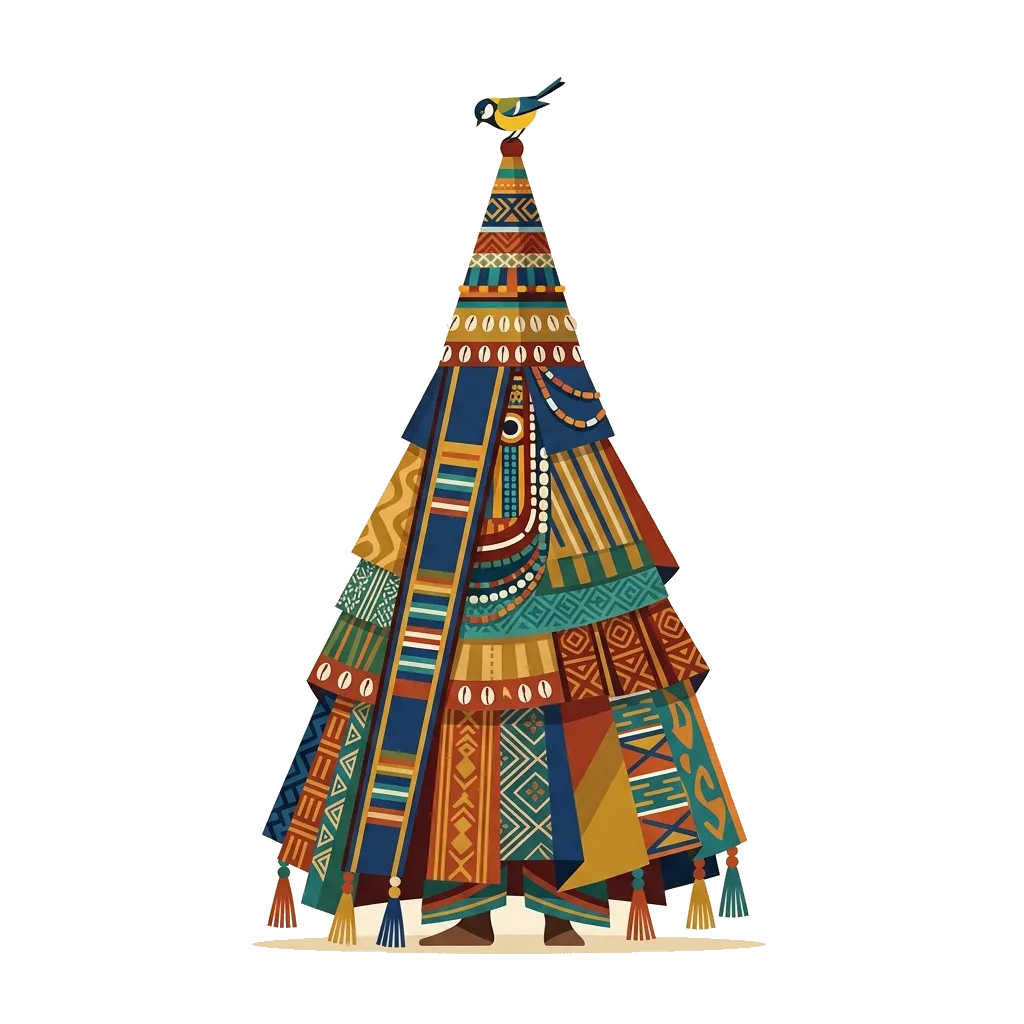
The Vodun priests take their place at the centre of the circle. Their clothes are sumptuous: ample robes in bright colours, necklaces of beads and cowries, ivory bracelets. Some wear masks or elaborate headdresses that signal their rank and preferred deity.
The high priest, recognisable by his carved staff and conical hat, begins the ceremony. He raises a calabash filled with water, turns to the four cardinal points, and speaks in the Fon language. His voice is deep, carried by the authority that a life dedicated to the sacred confers.
Initiates approach one by one to receive the blessing. The priest traces a sign on their forehead with white clay, whispers a prayer in their ear. Some waver with emotion, supported by other worshippers.
The eldest vodunsi sit apart. They do not actively participate, but their presence is essential. They are the guardians of tradition, those who remember the rituals from before colonisation, before forgetting. Their gaze reaches far, very far, as if they see something beyond what unfolds before them. I watch one woman in her nineties, back straight despite obvious effort, eyes fixed on something I cannot locate. She has seen every element of this ceremony repeated so many times that it has become indistinguishable from breathing.
To understand the role of these officiants in tradition, our guide to Vodun in Grand-Popo explores the different figures of the cult.
The offerings
The offering moment is one of the most intense of the day. Each family, each convent brings its gifts to the foot of the high priest. Kola nuts are arranged in a circle, sodabi bottles lined up, chickens held by the legs.
The priest blesses each offering with sacred water and clay powder. He lifts the kola nuts to the sky, breaks them, and interprets the cotyledons: a message from the gods about the year ahead. The crowd holds its breath. When he declares favourable omens, a murmur of relief runs through the assembly. A genuine murmur, of genuine relief — not applause, not enthusiasm, but the specific sound of a community exhaling.
The chickens are sacrificed according to rite. The blood is collected in a calabash, mixed with water and palm oil, then poured onto the sand altar. It is not violent: it is solemn. Every gesture is precise, every prayer accompanies the sacrifice. Families collect the poultry to prepare and share in communion.
Sodabi flows freely. Each participant is invited to drink a sip, pour a few drops on the ground for the ancestors, make a wish. The palm alcohol warms the chest and brings the living and the dead closer in a shared gesture.
A woman near me opens a packet of kola nuts, selects the firmest one, and carries it forward herself. She holds it for a long moment at arm's length, both hands. What she says, I cannot hear. But the gesture is unmistakably an offering of something personal. I understand, in that moment, that everything here is personal. The ceremony is collective but the prayer is singular. Each person has come with their own thing to say to the dead.
The climax
Around midday, the ceremony reaches its peak. The rhythms accelerate, the songs become more intense. The initiates, carried by trance, begin a dance that is not quite human. Their bodies are seized by spasms, their eyes roll back, their voices change.
The spirits descend. Each initiate is inhabited by the deity they serve. Those of Legba crawl on the ground like the old messenger of the gods. Those of Hevioso, the thunder god, leap imitating lightning. Those of Sakpata, the deity of earth and smallpox, roll in the dust.
The crowd watches with a mix of awe and reverence. Some weep. Others pray aloud. An old man approaches a possessed person to speak to them, consulting them as one would consult an oracle. The answer comes, cryptic, in a language only the man understands. He walks away, face transformed.
I am overwhelmed by the intensity of what I see. This is not a show. It is true, deeply true, with a truth that defies my Western reason. I do not understand everything, but I feel. I feel this presence, this connection, this indescribable thing that passes between humans and what lies beyond. The anthropological distance I had prepared — the note-taking posture, the observer's detachment — is not available to me. Something takes it away.
The night
Nightfall brings a new dimension to the celebration. The drums have not stopped all day. Torch flames illuminate faces, creating dancing shadows on the white walls of houses.
Ceremonies continue in the convents, away from view. Only initiates and concerned families participate. It is the most sacred moment, when Vodun's mysteries unfold in the intimacy of places of worship. I am not invited, and I do not try to be. My role as witness ends where the sacred begins. This limit — the line beyond which presence would be intrusion — is one I find easy to respect.
I walk alone on the beach. The drums reach me muffled by distance. The sea is calm, the stars countless above the Atlantic. I think about what I saw, what I felt. I think about the centuries of persecution Vodun has endured, its resilience, its rebirth. The 1997 recognition did not create this faith — it simply removed the prohibition that had tried to suppress it.
The beach at night is a different place. Shells and cowries left by the morning ceremony still lie in the sand above the tide line. I do not pick any up. They feel like they belong exactly where they are.
The next day, the town wakes slowly. The streets are strewn with cowries, feathers, footprints. The smell of incense still hangs. Families gather around leftovers from the previous day's meals. Children play with collected cowries. The drums have fallen silent, but their echo still resonates in my head.
What i felt
I left Grand-Popo on January 11 with a feeling I had never experienced before. It was not understanding, but rather a form of recognition. I had glimpsed something of Vodun's essence: a living religion, deep, rooted in the real and the everyday, yet open to the invisible.
What I had imagined as archaic beliefs revealed itself as a complex philosophy, a way of understanding the world and finding one's place in it. Vodun is not folklore for tourists. It is the soul of Benin, a soul that beats to the rhythm of drums, rises in song, weeps and laughs with its people.
I returned home transformed. Not converted — that is not the word. But changed in the way that real encounters with other people's truths tend to change you. More humble about the limits of what I know. More curious about the kinds of presence that do not announce themselves in any language I was taught to understand.
Every time I hear a drum, or see the colour white in a certain light, I find a fragment of that January 10 in Grand-Popo. A fragment of that day when, for a few hours, I had the chance to glimpse the invisible.
Plan Your Visit
Discover the magic of Grand-Popo with our curated local experiences.