









Grand-Popo is easily accessible from the main gateways of Benin and neighbouring Togo. Whether you fly into Cotonou, arrive by road from Lomé or come directly from Europe, several transport options are available. This guide covers every route with travel times, prices in CFA francs and euros, and practical tips for a smooth journey. To situate Grand-Popo in its wider context, read the complete Grand-Popo guide first.
Getting to Grand-Popo from Cotonou: taxi, bus or rental car
Cotonou International Airport (COO) is the main entry point for international travellers. From there, Grand-Popo is about 90 kilometres west, roughly 2 to 2.5 hours by road under normal conditions. The RN1 national road, connecting Cotonou to the Togolese border, is generally in good condition, with the occasional pothole after heavy rains. Leave before 9am for the smoothest journey.
By private taxi
The most comfortable and recommended option for new arrivals. The taxi picks you up directly outside the airport or at your Cotonou hotel.
- Duration: 2h00 to 2h30
- Price: 25,000 to 35,000 FCFA (38 to 53 EUR)
- Tip: negotiate the price before departure, agree on a return meeting point, and consider arranging the transfer through your Grand-Popo lodge, which often has trusted drivers
By bush taxi
The economic option favoured by locals and budget travellers. Departures from Dantokpa, Cotonou's main inter-city bus station in the Zongo district near the Grand Market. To reach it from the airport, take a zemidjan and ask for "Dantokpa gare" (about 20 minutes, 2,000 to 3,000 FCFA). The station operates from around 5am: earlier departures are fuller and faster, as drivers leave once the vehicle is packed. Shared Peugeot 504 taxis and minibuses both serve the Grand-Popo route. Some departures also leave from Arconville, a secondary stop closer to the western neighbourhoods and slightly more accessible from the airport.
- Duration: 2h30 to 3h00 (more stops)
- Price: 3,000 to 5,000 FCFA (5 to 8 EUR) per person
- Tip: leave early morning to avoid heat and traffic; the ride becomes significantly more uncomfortable after midday
By rental car
Renting a car gives you the freedom to stop along the way at fishing villages, small markets and viewpoints that bush taxis pass without slowing. Rental agencies are available in Cotonou (Avis, Europcar, local agencies near the airport).
- Rental price: from 30,000 FCFA (46 EUR) per day
- Fuel: about 5,000 FCFA (8 EUR) for the one-way trip
- Route: take the RN1 national road west toward Lomé; GPS works well on this stretch
Coming from Lomé and crossing the Hilacondji border
Grand-Popo is only 20 minutes from the Togolese border, making it one of the easiest coastal destinations to reach from Lomé.
Route from Lomé
- Distance: about 60 km
- Duration: 1h00 to 1h30
- Route: Lomé eastward along the coastal road, crossing at Hilacondji border, then 15 to 20 minutes to Grand-Popo
Crossing the Hilacondji border
Hilacondji is one of West Africa's busiest border posts. The procedure is straightforward but can be slow during peak hours.
- Present your passport at the Togolese exit post
- Cross the no-man's-land (a few hundred metres on foot)
- Present your passport at the Beninese entry post
- An entry visa is issued on arrival for most nationalities (12,000 FCFA / 18 EUR)
ECOWAS nationals are exempt from visas. Allow 30 to 60 minutes for formalities during quiet periods, and up to two hours on weekends or public holidays. The best time to cross is between 6am and 8am, when vehicle and pedestrian flow is minimal. Both Togolese and Beninese CFA francs are identical and interchangeable: you do not need to exchange money at the crossing. European nationals should apply for an e-visa at evisa.gouv.bj at least 72 hours before departure. A small fee (around 1,000 FCFA) is sometimes requested for photocopying documents; this is unofficial but common practice, and quietly declining is also accepted.
Prices from Lomé
- Private taxi from Lomé to Grand-Popo: 20,000 to 30,000 FCFA (30 to 46 EUR)
- Bush taxi to the border, then new taxi: 5,000 to 8,000 FCFA (8 to 12 EUR) total
- Zemidjan from border to Grand-Popo: 500 to 1,000 FCFA (0.80 to 1.50 EUR)
More details on the Grand-Popo to Lomé route.
Flying to Cotonou from Europe and onward to Grand-Popo
Travellers from Europe generally arrive at Cotonou International Airport, one of the smallest international airports on the continent but surprisingly efficient for its size.
Flights to Cotonou
| Airline | Departure | Duration | Return price |
|---|---|---|---|
| Air France | Paris-CDG | 6h00 | 600 to 900 EUR |
| Brussels Airlines | Brussels | 6h30 | 550 to 850 EUR |
| Turkish Airlines | Istanbul (via) | 8h00 | 500 to 800 EUR |
| Ethiopian Airlines | Addis Ababa (via) | 9h00 | 450 to 750 EUR |
Book at least two months ahead for the best rates; fares rise sharply in December and January around the Vodun Day period.
Once in Cotonou, follow the section above to reach Grand-Popo.
Alternative: arrive via Lomé
You can also fly to Lomé (Togo) via Brussels Airlines, Air France or Ethiopian Airlines, then reach Grand-Popo by road in 1.5 hours. This option is worth checking if Lomé fares are lower on your dates. Lomé's airport is compact and immigration is often faster than Cotonou's, making it a viable alternative arrival point. The Hilacondji crossing is among the easiest in the subregion.
Arriving at Cotonou airport: what to expect
The arrival process takes between 45 minutes and 1.5 hours depending on queues. After landing, proceed to passport control: the e-visa lane moves noticeably faster if you applied in advance at evisa.gouv.bj. Customs is generally straightforward for travellers with standard luggage. Exit through the single arrivals hall where taxi drivers wait outside. Avoid unofficial drivers who approach you inside the terminal. Negotiate outside the main exit, or arrange a transfer through your accommodation in advance.
For luggage, pack light if you plan to use bush taxis: large suitcases attract additional fees and may not fit in shared vehicles. A 45-litre bag and a daypack work comfortably for stays of one to two weeks.
Tips for air travellers
- Book at least two months ahead for the best fares, especially for December and January travel
- Night flights arriving after 8pm: plan a night in Cotonou rather than driving to Grand-Popo in the dark, when road visibility is poor and police checkpoints multiply
- Low-cost airlines do not yet serve Cotonou or Lomé, so fares are relatively stable year-round
- Apply for your Beninese e-visa at evisa.gouv.bj before departure; the process takes 48 to 72 hours and allows you to skip the visa queue on arrival
Getting around once in Grand-Popo
Once on site, several local transport options make moving between neighbourhoods simple and affordable.
Zemidjan (motorbike taxi)
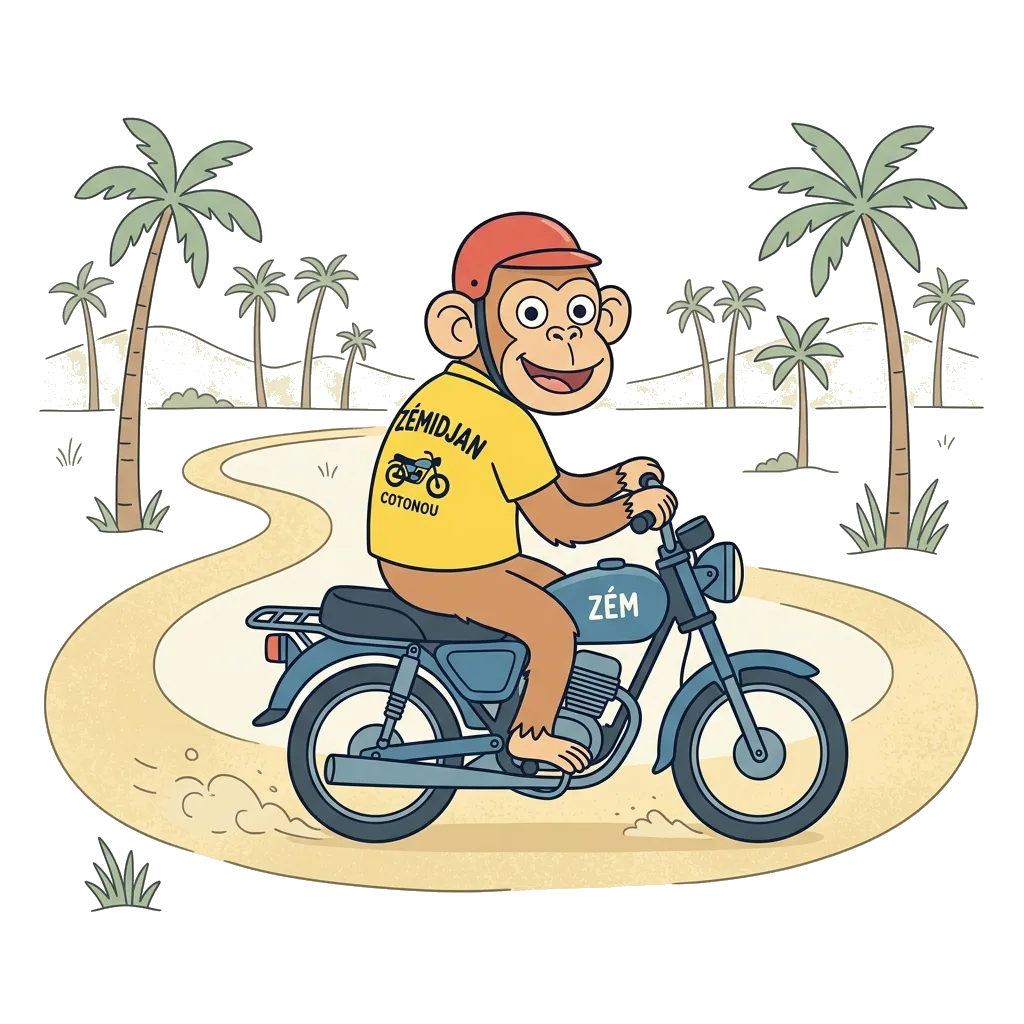
The king of the road in Grand-Popo. These motorbike taxis are everywhere and are the most practical option for short trips.
- Price: 200 to 500 FCFA (0.30 to 0.80 EUR) per trip within town
- Tip: negotiate the price before getting on; say "prix local" to avoid the tourist rate, which is typically double
Taxi
A few shared taxis run between neighbourhoods and nearby villages.
- Price: 500 to 1,500 FCFA (0.80 to 2.30 EUR) depending on distance
Bicycle
Grand-Popo is flat and well suited to cycling. Most waterfront lodges and several rental shops offer bikes by the day. A bicycle gives you the freedom to stop anywhere along the coast without depending on a driver or schedule.
- Bicycle rental price: 3,000 to 5,000 FCFA (5 to 8 EUR) per day
- Ideal for exploring the coast at your own pace, particularly the stretch between Lion Bar and Adjaha
On foot
Walking is underrated in Grand-Popo. The town centre, the historic Sobrado quarter and the main beach are all within easy reach on foot. From the central Avlo market to the beach takes about 10 minutes at a comfortable pace. From Lion Bar to the Gbakpodji pirogue landing stage is about 25 minutes walking through coconut groves. From the market to Bouche du Roy on foot along the shore takes 2.5 hours. This is a small town: your legs are often the best option, and the walk itself is part of the experience.
Renting a vehicle in Grand-Popo or Cotonou
Renting a vehicle is recommended for travellers who want to explore the surrounding area independently, particularly the Route des Pêches west of Lion Bar, which requires a vehicle with decent ground clearance.
- Standard car: 30,000 to 50,000 FCFA per day (46 to 76 EUR)
- 4x4: 50,000 to 80,000 FCFA per day (76 to 122 EUR), recommended in rainy season
- Scooter: 10,000 to 15,000 FCFA per day (15 to 23 EUR)
Note: an international driving permit is required to drive in Benin. Police checks are frequent on the national road, so always carry your passport, licence and vehicle registration together in an accessible pocket.
Transport prices at a glance: FCFA and EUR
| Route | Transport | Duration | Price (FCFA) | Price (EUR) |
|---|---|---|---|---|
| Cotonou to Grand-Popo | Private taxi | 2h30 | 25,000-35,000 | 38-53 |
| Cotonou to Grand-Popo | Bush taxi | 3h00 | 3,000-5,000 | 5-8 |
| Lomé to Grand-Popo | Private taxi | 1h30 | 20,000-30,000 | 30-46 |
| Border to Grand-Popo | Zemidjan | 15 min | 500-1,000 | 0.80-1.50 |
| Local trip | Zemidjan | 5-15 min | 200-500 | 0.30-0.80 |
| Bicycle rental | Bicycle | 1 day | 3,000-5,000 | 5-8 |
| Car rental | Car | 1 day | 30,000-80,000 | 46-122 |
Practical road tips for driving in Benin
- Best time to drive: between 6am and 10am. Heat and traffic intensify after midday, and late afternoon on the RN1 is particularly congested near Cotonou.
- Road conditions: the RN1 is paved and in reasonable condition. The Route des Pêches is a laterite track that turns impassable in parts after heavy rain.
- Police checkpoints: barriers appear every 30 to 50 kilometres on the RN1. Officers check your passport, driving licence and vehicle registration. Stay calm, greet politely in French ("Bonjour") and hand over documents without argument. Searches are rare for tourist vehicles. Never offer money unprompted; if asked for an unofficial "fee," ask calmly for a written receipt and the situation usually resolves itself quickly.
- Flat tyres: potholes appear after heavy rains even on the main road. Carry a spare and locate it before you need it. In villages, informal mechanics called vulcanisateurs can patch a tyre for 500 to 1,000 FCFA. Ask any roadside vendor to point you to one.
- Fuel: service stations are available in Grand-Popo (on the RNIE1) and regularly along the national road. Fill up before leaving Cotonou rather than relying on the informal roadside sellers.
- Water and snacks: bring at least 1.5 litres of bottled water per person; the heat during the journey can be intense between 11am and 4pm.
Tips for solo women travellers
Grand-Popo is generally safe for women travelling alone. Several practical habits help make the journey friction-free.
- In shared taxis and bush taxis: request a window seat. This gives you more personal space and easier control over your belongings in a packed vehicle.
- At the Hilacondji border: cross during daylight hours. The crossing is manageable but crowded; keep your bag in front of you and your passport in an internal pocket rather than a visible pouch.
- With zemidjans: your accommodation can usually recommend specific drivers they trust. Having a saved contact number for a reliable driver removes the need to negotiate from scratch each time you need transport.
- At night: the same rule that applies to all travellers applies with more weight here. Stick to lit areas after dark, use a taxi called through your lodge rather than flagging one from the street, and let someone know your expected return time when you go out.
The journey to Grand-Popo is part of the experience. The road hugs the coast, passes through fishing villages and offers glimpses of the Atlantic through the coconut palms. Take time to enjoy the ride.
Plan Your Visit
Discover the magic of Grand-Popo with our curated local experiences.