


There are evenings in Grand-Popo when the ocean falls silent all at once. The wind drops, the waves flatten, a strange light lingers on the water. Fishermen who have spent their lives on this coast know the feeling well, even if the moment defies easy explanation. It is the kind of stillness that carries a name here: Mami Wata.
Who is Mami Wata
Mami Wata — "Mother of the Water" in pidgin — is a spirit venerated along the entire West African coast, from Guinea to Cameroon, and well beyond in the diasporas of the Americas and the Caribbean. In Grand-Popo, as across much of the Gulf of Guinea, she belongs to the Vodun pantheon without being fully reducible to it: a figure somewhere between a nature spirit, a protective deity and a warning.
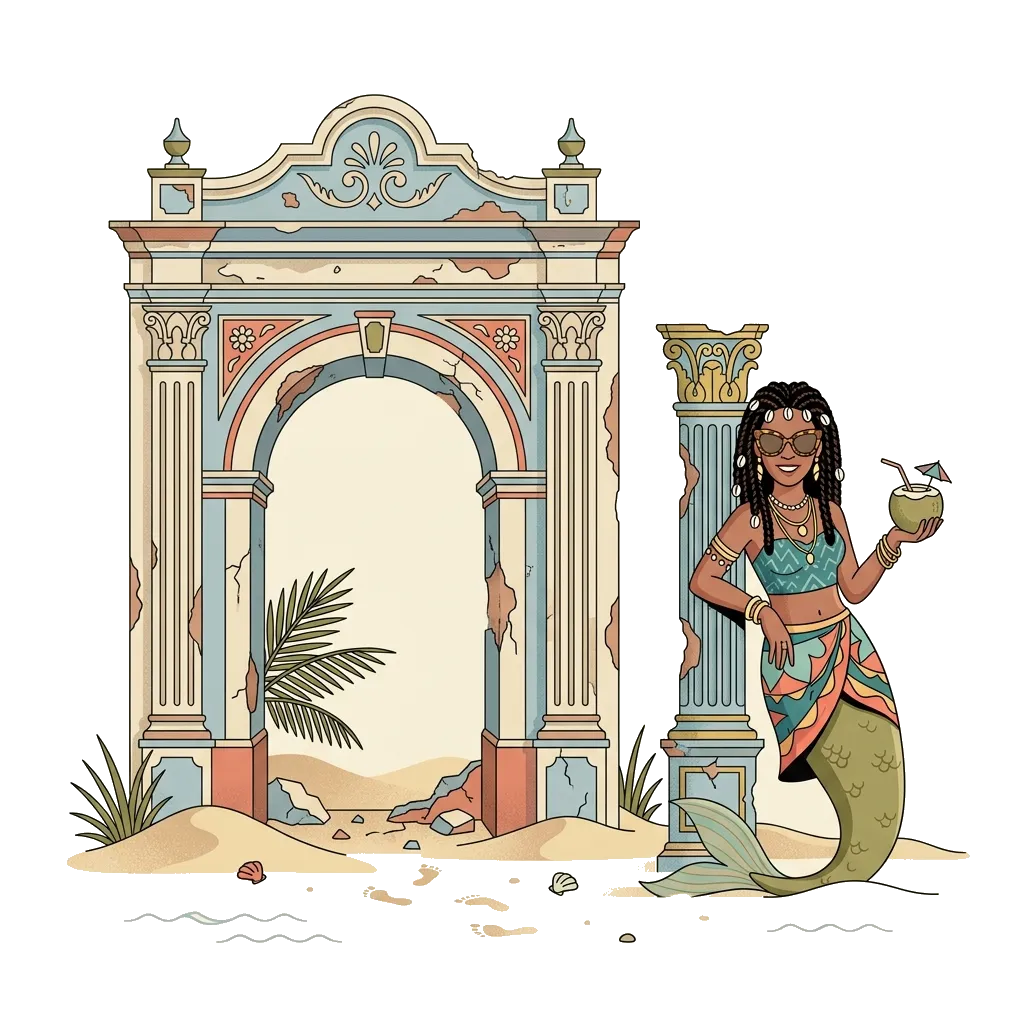
She is usually depicted as a woman with pale or shining skin, long hair, sometimes with a fish tail — hence the comparison, widely spread by European travellers' accounts, with the figure of the mermaid. But reducing Mami Wata to a Western mermaid would miss the point: she is above all a force governing the waters, capable of granting wealth and fertility to those she favours, and reclaiming what she has given from those who fail to respect the ocean.
Aziri, before the name changed
Before Europeans arrived, she wasn't yet called Mami Wata on this coast. The local name was Aziri — "She Who Owns Wealth." According to accounts gathered in the region, Aziri already inhabited the rivers of the Niger and the lagoons of Benin long before maritime trade brought new images that would come to overlay hers: European mermaid figures, carried by sailors and traders from the 15th century onward, gradually merged with the pre-existing water deity. The name "Mami Wata" eventually became dominant, but Aziri remains the name local tradition has always recognised for her.
This double identity — an ancient figure of river and lagoon, overlaid by imagery brought in from the sea — sums up rather well how the beliefs of the Beninese coast have always absorbed what arrived by water without losing their local roots.
The museum at Villa Karo
In Grand-Popo, the best way to encounter Mami Wata isn't to hope for a glimpse on the water, but to visit the small museum devoted to her at Villa Karo, the town's Finnish-Beninese cultural centre. There you'll find a mural depicting her emerging from the ocean, a snake at her waist and a mirror in her hand — two recurring attributes of her iconography. A statue shows her with a tail covered in golden scales, holding a comb and a snake.
The museum also displays a shimmering altar, loaded with fake gold coins and empty champagne bottles — the offerings traditionally made to a deity associated with prosperity and abundance. A saltwater basin lets visitors leave their own offerings. And in a gesture that says much about the vitality of this tradition, a contemporary installation presents "Mami Wata 2.0, goddess of social media" — proof that the figure keeps evolving with its time rather than staying frozen in folklore.
To plan this visit as part of a broader stop at Villa Karo, our article on Villa Karo details opening hours and the centre's other collections.
The legend of the mirror
Among the objects on display is a 19th-century mirror bordered with shells — a historical piece, not a reconstruction. A local legend tells of a young woman who is said to have disappeared while gazing into it for too long, drawn in by her own reflection or by something behind it. It's the kind of story told in a lowered voice in front of the display case, neither quite fact nor quite fiction — exactly the place Mami Wata occupies in the local imagination: real enough to make you think twice before leaning too close to the water, legendary enough to remain a good story to tell in the evening.
Our guide to Vodun in Grand-Popo situates this figure within the region's broader spiritual context, alongside the Zangbeto and the Egungun.
FAQ
Where can you discover Mami Wata in Grand-Popo? At the museum devoted to her at Villa Karo, with a mural, statues, an altar and historical objects.
Who is Aziri? The local name for Mami Wata before European influences arrived — "She Who Owns Wealth" in the local language.
Where does the resemblance to European mermaids come from? From a historical blend between a pre-existing water deity (Aziri) and the imagery of mermaids brought in by maritime trade from the 15th century onward.
Is the museum paid entry? It's part of the Villa Karo visit — see our dedicated article for current hours and rates.
Is Mami Wata part of Vodun? She is closely associated with it, like many water deities in the region's spiritual pantheon.
Plan Your Visit
Discover the magic of Grand-Popo with our curated local experiences.