






When you step onto the sand of Grand-Popo, you are walking on centuries of history. This narrow strip of coast between the Mono River and the Atlantic Ocean has been the stage for migrations, flourishing trading posts, tragic slave routes and cultural rebirths. Understanding the history of Grand-Popo means grasping the soul of this unique land.
Start your exploration with our complete guide to Grand-Popo to situate this history in its present context.
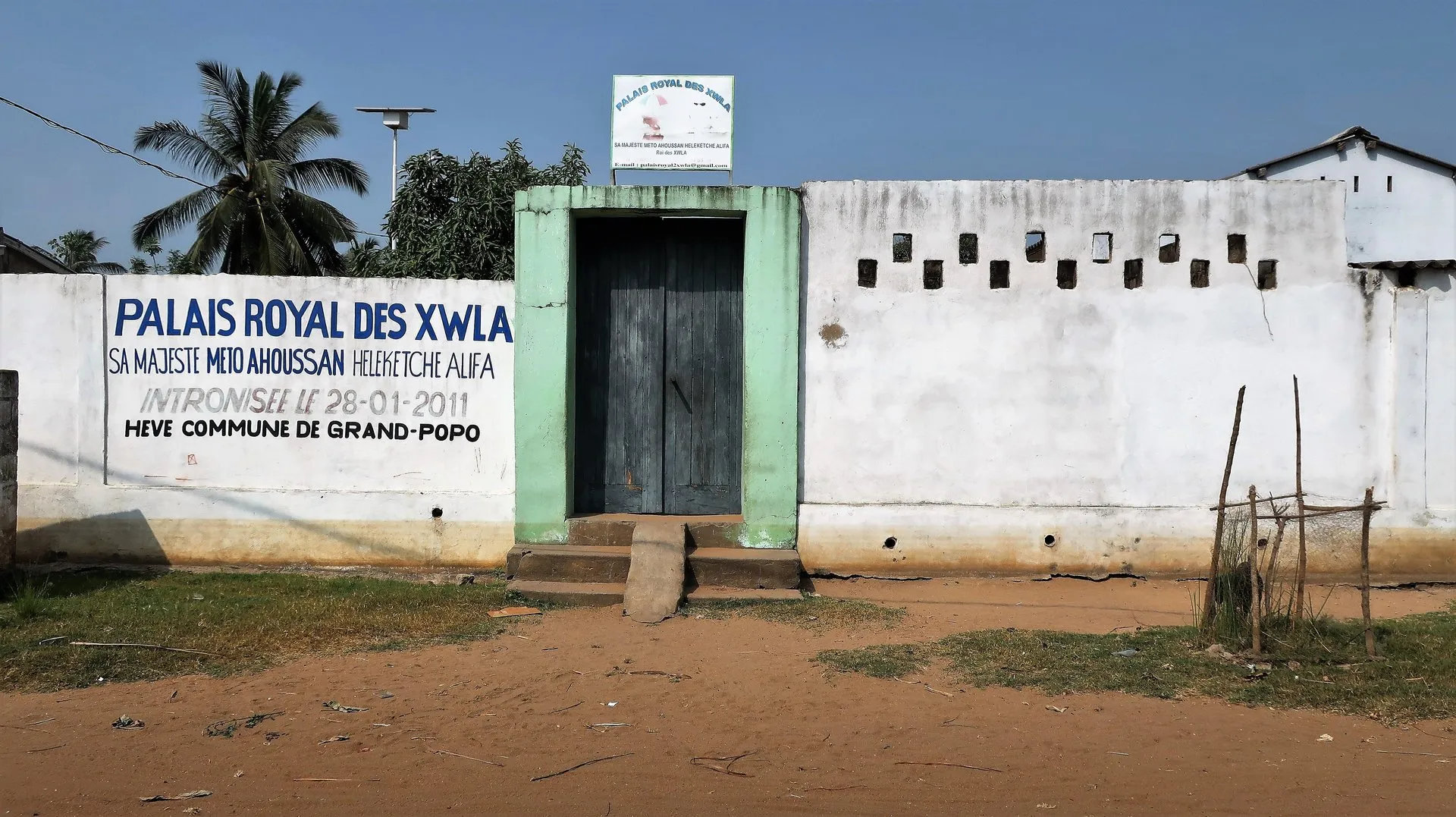
Origins: the Xwla people and their coastal society
Grand-Popo's story begins with the Xwla people, a branch of the larger Gbe group who settled on this narrow tongue of land between lagoon and ocean. The word "Popo" itself may come from the name that early European navigators gave to these coastal people, though Xwla elders maintain that the term predates any European contact.
The Xwla were above all fishermen and navigators. The Mono River was their highway, the ocean their pantry. Their knowledge of currents and winds allowed them to trade along the Gulf of Benin long before the Europeans arrived. Xwla villages dotted the coastline, organised into clans led by land chiefs and Vodun priests.
Xwla society was structured around patrilineal clans, each holding specific rights over fishing territories, sacred groves and ritual ceremonies. The clan chief, known as the tovi, managed disputes, collected tribute and represented the community before the Vodun shrines. Fishermen did not work alone: they organised in cooperative groups, dividing the catch according to strict rules that ensured every family received its share. Knowledge of the sea passed from father to son through oral instruction and apprenticeship on the water from early childhood. This knowledge system was sophisticated enough to predict seasonal fish migrations and read weather patterns that no European instrument could yet measure.
Grand-Popo's lagoon system gave the Xwla a geographic advantage no neighbouring group enjoyed. By controlling the passage between the Mono River and the open Atlantic, they positioned themselves as natural intermediaries in regional trade long before any European ship appeared on the horizon. Salt, dried fish and woven mats moved inland along river routes in exchange for agricultural produce and iron tools from the plateau peoples.
Discover more about the culture and traditions of the Xwla people.
The golden age of trade: European comptoirs on the Beninese coast
From the 15th century onward, Grand-Popo's coast became a major commercial crossroads. Portuguese navigators were the first Europeans to reach these shores, around 1480, followed by the Dutch in the early 17th century, then the English and French. Grand-Popo was not a deep-water port, but its strategic position midway between Ouidah and present-day Togo made it an ideal trading post.
Trade centred on palm oil, ivory, textiles and spices. The Dutch West India Company established one of the earliest permanent factories on this stretch of coast, a fortified warehouse known as a comptoir, where goods were stored, weighed and exchanged. Grand-Popo enjoyed a period of prosperity that attracted populations from across the region.
Exchanges were not only economic: they were cultural, linguistic and religious. Marriages between European merchants and Xwla women gave birth to the first mixed-race families who would later play key roles as brokers and interpreters. These families occupied a difficult middle ground: trusted by neither side completely, valuable to both. Their descendants can be traced in some of Grand-Popo's oldest family names today.
By the mid-17th century, competition between European powers intensified. The Dutch, English and French were all trying to secure exclusive access to local suppliers. Grand-Popo's position between two colonial spheres of influence meant it changed hands several times. This instability paradoxically preserved a degree of Xwla autonomy: no single power ever fully controlled the town. The Xwla learned to play competing European interests against one another, a diplomatic skill that served them well for two centuries.
The slave trade: Grand-Popo's role in the Atlantic deportations
This chapter of Grand-Popo's history is the most painful. From the 17th to the 19th century, the Atlantic slave trade transformed the Gulf of Benin into a hub for deporting Africans to the Americas. Grand-Popo, though less documented than neighbouring Ouidah, played a role in this tragic commerce.
Captives arrived from the interior, primarily through the Kingdom of Dahomey, whose warrior armies raided neighbouring peoples and delivered captives to coastal merchants in exchange for firearms, cloth and alcohol. They were held in fortified trading posts on the coast while awaiting slave ships. Bouche du Roy, where the Mono River meets the Atlantic, served as one of the most discreet embarkation points on this stretch of coast. The complex of lagoons and river channels allowed slavers to move captives at night, away from the eyes of competing European powers and local witnesses.
Historians estimate that between 400,000 and 600,000 Africans were deported from the Beninese coast as a whole between 1650 and 1850. Grand-Popo's share was smaller than Ouidah's partly because of its relative geographical obscurity, but the town was nonetheless a transit node. The Kingdom of Dahomey exercised a dominating influence over the coastal towns throughout this period. Grand-Popo oscillated between Dahomean control and fragile independence, its fate tied to the military campaigns of a kingdom it could not resist.
Today's Agouda families carry the memory of this tragedy: they are the descendants of those who returned from Brazil after abolition.
Read more on this subject in our article on the Slave Route at Grand-Popo.
French colonial rule and its impact on Xwla traditions
In 1894, Benin became French Dahomey. Grand-Popo was integrated into the colony and underwent profound changes. The French colonial administration built government buildings, a school and a dispensary. The town became a district capital, granting it regional administrative importance.
Villa Karo was built in 1910 to serve as the residence of the French district commander, then known as the commandant de cercle. The first commander to occupy the building oversaw the restructuring of local governance, replacing traditional clan authority with appointed chiefs loyal to the colonial administration. The building's thick walls, wide verandas and elevated position above the surrounding land were deliberate architectural choices designed to project permanence and authority. Today visitors enter the same building as a Finnish-Beninese cultural centre: the contrast between its colonial origin and its current role as a space for artistic exchange is striking.
The economy was reorganised around export crops: oil palm, coffee and cotton. Families who had lived from fishing and river trade were pushed toward an export economy that served metropolitan France. Catholic missionaries opened missions and schools, and within a generation a portion of the Xwla population had converted. Traditional Xwla society was deeply disrupted: customary chiefs saw their authority diminish before the district commander.
Yet the traditions resisted. Vodun, Egungun masks and Zangbeto continued to exist in the shadow of colonial power, preserving their essence through clandestine ceremonies held away from colonial eyes. This survival was not passive: it was an act of cultural defiance that communities maintained for decades, passing knowledge through trusted networks of initiates until today.
The Afro-Brazilian return: Agoudas, Sobrado houses and cultural fusion
One of the most layered chapters in Grand-Popo's history is the return of former slaves. After Brazil abolished slavery in 1888, freed families chose to return to their ancestors' land. These Agoudas brought with them a unique heritage: Sobrado architecture, Catholic faith blended with Vodun, Bahian-influenced cuisine, and illustrious family names that still appear on the doors of the oldest houses in town.
A Sobrado house is immediately recognisable in Grand-Popo's historic quarter. Two or three storeys high, it is built around a central courtyard. The facade features symmetrical windows framed by painted shutters, typically in faded blue or ochre. Wrought-iron balconies on the upper floors allowed residents to catch sea breezes while observing the street below. Interior rooms were separated by carved wooden doors, and the ground floor often housed a commercial space where the returning family conducted trade. The materials, the proportions and the decorative details all speak to 19th-century Salvador de Bahia transplanted onto West African soil.
The culinary traces are equally concrete. Acarajé, the Bahian street food made from black-eyed pea fritters deep-fried in palm oil, returned to Grand-Popo as accra, still sold at roadside stalls today. Slow-cooked stews enriched with tomato and onion, recipes carried in memory across the Atlantic, merged with local ingredients and Xwla cooking methods to produce a cuisine found nowhere else in Benin. A dish that began its journey in West Africa, crossed the ocean in the hold of a slave ship, evolved in Brazilian kitchens over two centuries, and returned transformed: this is what living history tastes like.
In the 19th century, the da Silva, de Souza and Medeiros families settled in Grand-Popo's historic quarter. This Benin-Brazil cultural fusion is a living heritage you can still admire, taste and trace with a knowledgeable guide.
Explore this story further in our article on Afro-Brazilian heritage and the Agoudas.
Grand-Popo today: cultural revival and coastal challenges
Since the 1990s, Grand-Popo has experienced a sustained revival. The official recognition of Vodun as a state religion in 1996 allowed traditions to emerge from the shadows and be proudly displayed. The 10th of January, Vodun National Day, is a powerful moment when Grand-Popo vibrates to the sound of drums and the streets fill with processions in ceremonial dress.
Cultural and ecological tourism has developed steadily, drawn by the wild beauty of the coastline and the richness of traditions. Bouche du Roy is a UNESCO Biosphere Reserve. Local initiatives such as ecolodges, conservation programs for sea turtles and village-guided tours encourage respectful tourism that benefits communities directly. Associations like the Groupement des Guides Touristiques de Grand-Popo and the cultural cooperative Nonvitcha work to ensure that tourism revenue stays within the local economy rather than flowing to outside operators.
Two challenges now define Grand-Popo's present as much as its past. Coastal erosion is accelerating: the Atlantic is eating into the shoreline at a rate of one to three metres per year in some areas, threatening homes, historic buildings and the fishing economy that has sustained the Xwla for centuries. Entire neighbourhoods that existed twenty years ago have been swallowed. Residents have relocated inland, retaining walls have been built along the most vulnerable stretches, and mangrove replanting programs are active near the river mouth, though the long-term picture remains uncertain.
The second challenge is keeping tourism genuinely beneficial. Grand-Popo attracts visitors who want an authentic experience, but authenticity requires active work to protect it. The debate about how to welcome more visitors without losing what makes the town worth visiting runs through every conversation between community organisations, local guides and accommodation owners.
Historical sites you can visit in Grand-Popo
| Site | Description | Area |
|---|---|---|
| Villa Karo | Former colonial residence built 1910, now a Finnish-Beninese cultural centre | Centre |
| Old trading post ruins | Remnants of 19th-century European factories | Waterfront |
| Gbecon House | Preserved 19th-century Sobrado house | Historic quarter |
| Central market | Trading hub since colonial times | Town centre |
| Mono River landing stage | Historic fluvial commerce point, active today | Mono banks |
FAQ
What is the origin of the name Grand-Popo? The name likely comes from the Xwla term "Popo" for the coastal people, combined with the Portuguese "Grande" from 16th-century European navigators. The dual origin reflects the town's role as a meeting point between African and European worlds.
When was Grand-Popo founded? The first Xwla settlements date back to at least the 14th century. European trading posts appeared from the late 15th century onward.
What are the main historical events of Grand-Popo? The Xwla settlement, establishment of European trading posts, the slave trade, the French colonial period, the Agoudas' return from Brazil, the 1996 recognition of Vodun as a state religion, and the ongoing response to coastal erosion.
Can I visit Grand-Popo's historical sites? Yes. Villa Karo, Gbecon House and the trading post ruins are accessible. A local guide is strongly recommended for historical context, particularly for the Sobrado houses where architectural details only reveal their meaning with explanation.
When was Villa Karo built? Villa Karo was built in 1910 during the French colonial period. It served as the residence of the district commander before being converted into a Finnish-Beninese cultural centre. Today it hosts artist residencies, exhibitions and community events open to visitors.
What is coastal erosion doing to Grand-Popo? The Atlantic shoreline at Grand-Popo is retreating at an estimated one to three metres per year in the most exposed areas. Houses, historic buildings and fishing infrastructure have already been lost. The process is driven by a combination of natural wave action and the disruption of sediment flows caused by dam construction upstream on the Mono River. Local conservation groups conduct mangrove replanting and dune protection programs, supported in part by responsible tourism revenue. The problem is serious but communities are actively engaged in finding responses.
Plan Your Visit
Discover the magic of Grand-Popo with our curated local experiences.