







Each year from September to March, the beaches of Grand-Popo become the stage for one of nature's oldest rituals. Sea turtles return to lay their eggs on the very same shore where they hatched, having travelled thousands of kilometres across the ocean. Watching a turtle dig her nest under the moonlight is one of the most moving experiences the coast offers.
Watching sea turtles Grand-Popo is a privilege that demands respect and discretion. This guide covers everything you need to know to experience this encounter responsibly while supporting local conservation efforts.
For an overview of the region's natural wealth, see our nature and ecotourism guide.
Three species that have chosen these beaches
Three sea turtle species regularly visit the Grand-Popo coast to nest.
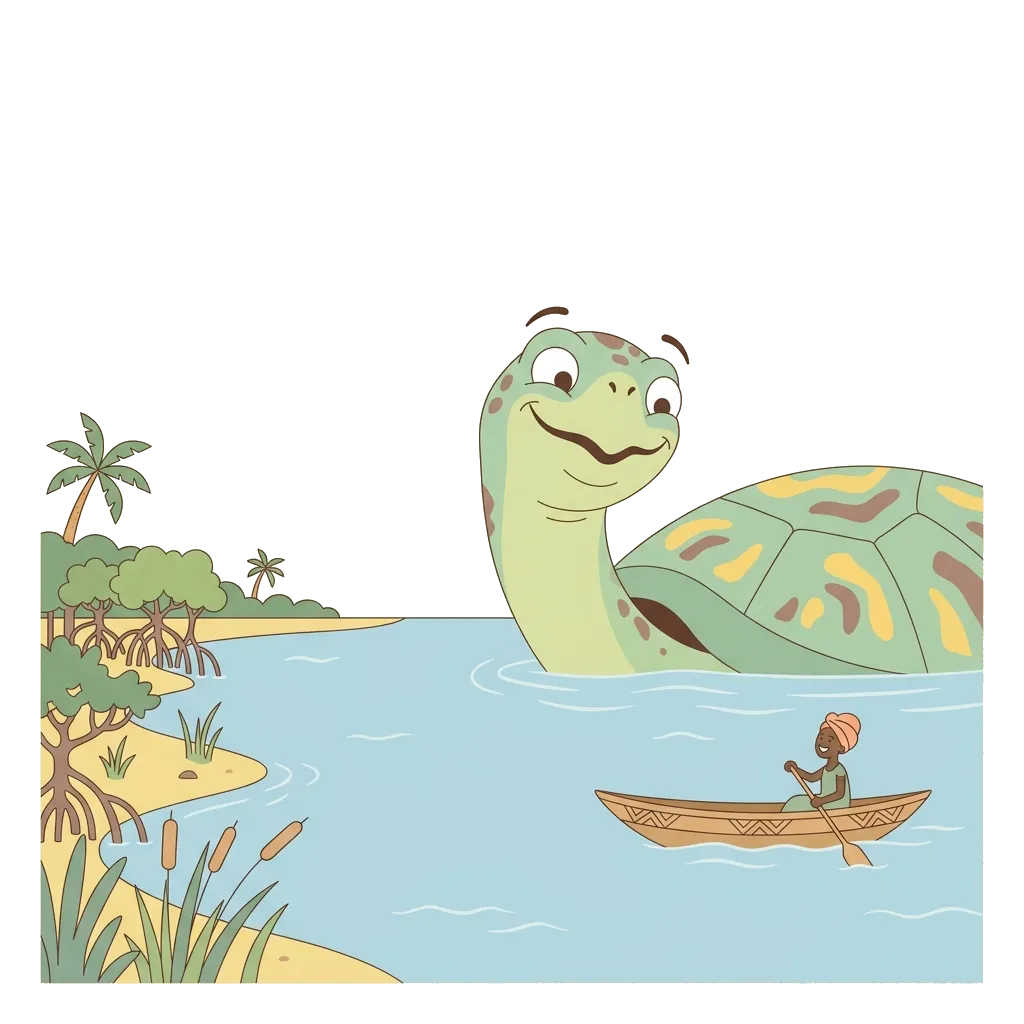
The green turtle (Chelonia mydas) is the most common. Recognisable by its rounded shell and olive-brown scales, it can weigh up to 200 kilograms and reach 1.2 metres in length. Its diet is mainly vegetarian: it feeds on seagrasses and algae abundant near the Beninese coast. Adult green turtles are known to gather in feeding grounds hundreds of kilometres from their nesting beach; the individual that climbs onto the sand at Bouche du Roy tonight may have spent the last three years grazing on a seagrass meadow off the coast of Ghana. A female in motion on the beach breathes in long, visible exhalations — the effort of moving two hundred kilograms on land is audible.
The hawksbill turtle (Eretmochelys imbricata) is smaller (around 80 centimetres and 60 to 80 kilograms), with a pointed beak resembling a raptor's. Its overlapping shell scales are brown mottled with yellow and orange. This is the most threatened of the three, classified as critically endangered by the International Union for Conservation of Nature (IUCN). Its population has declined by more than 80 percent over three generations, mainly due to poaching for its distinctive shell, once used for tortoiseshell jewellery and combs.
The olive ridley turtle (Lepidochelys olivacea), the smallest of the three, measures about 70 centimetres and weighs 35 to 50 kilograms. Its heart-shaped shell has a characteristic olive green colour. It is known for mass nesting events called arribadas, where hundreds of females come ashore simultaneously. These events have been recorded on the Beninese coast, though less frequently than on the Pacific shores where the species is more studied.
All three species are protected by Beninese law and international conventions. Their presence on Grand-Popo's beaches testifies to the preserved quality of this coastal ecosystem.
The nesting ritual: a night of ancient work
The sea turtle life cycle is an extraordinary journey that begins and ends on the same beach. Females reach sexual maturity between 20 and 30 years, depending on the species. They return to nest on the exact beach where they were born, guided by the Earth's magnetic field.
The nesting ritual unfolds with majestic slowness. The female emerges from the water under cover of night, when sand temperatures are cooler and predators less active. She labours across the sand beyond the tide line, searching for a dry, open spot.
Using her rear flippers, she digs a gourd-shaped hole about 40 to 50 centimetres deep. This meticulous work can take over an hour. She deposits between 80 and 150 round eggs, the size and colour of ping-pong balls, with a soft, parchment-like shell. After covering the nest with sand, tamping it carefully with her shell, she returns to the ocean, exhausted. The return journey is slightly faster than the approach — the ocean is pulling her back.
Incubation lasts 45 to 70 days depending on sand temperature. The temperature also determines the sex of the hatchlings: warm sand (above 29 degrees Celsius) produces females, cooler sand produces males. An equilibrium that climate change directly threatens. The babies, barely five to seven centimetres long, emerge together at night and dash toward the sea, guided by the moonlight reflecting on the water. Ghost crabs and predatory birds await many of them; the fraction that reach the surf face further dangers in the open ocean. Only one in a thousand hatchlings will survive to adulthood — making every adult female on this beach a minor miracle.
When to come to see them
The sea turtle nesting season in Grand-Popo runs from September to March, with peak activity between November and January. Each female may lay two or three times per season, at intervals of two to three weeks.
The best time to watch turtles is at night, between 9 pm and 3 am, when females come ashore to lay. Hatchlings emerge about two months after laying, mainly between November and May. This is a rarer but absolutely fascinating spectacle. The emergence is collective: dozens of babies push upward through the sand simultaneously, and when the first one breaks through, the others follow within minutes, a sudden eruption of small dark shapes heading instinctively toward the brightest horizon.
Tides play an important role. High tide and full moon nights are particularly favourable, as the sea rises higher on the beach, giving females easier access to nesting areas.
Where turtles choose to nest
Grand-Popo's beaches offer several nesting sites monitored by local conservation teams.
The beach in front of Bouche du Roy is the main site. This preserved area, where human activity is limited, offers ideal conditions for turtles. Access is by pirogue from central Grand-Popo or by road to Avlo village. The darkness here is complete on moonless nights — no artificial light reaches from the village, which is precisely what the turtles need.
The coastline between Grand-Popo and Agoue includes several wild beaches frequented by turtles. Less accessible and therefore quieter, they offer the best observation chances for visitors accompanied by a guide. The loose community of fisherfolk along this stretch has become accustomed to reporting nests they find during their pre-dawn launches.
The beaches in front of ecolodges in the area are sometimes nesting sites. Some accommodations participate in monitoring programmes and can organise night outings for their guests. Staying at one of these lodges during nesting season means the possibility of a turtle arriving just metres from your door.
It is essential never to go alone on the beaches at night to watch turtles. Outings must always be led by a guide accredited by conservation associations, who knows the protocols to avoid disturbing the animals.
Conservation programmes that protect every nest
Several local initiatives work actively to protect sea turtles in Grand-Popo.
Nature Tropicale association has run a nesting site monitoring programme since 2015. Its teams patrol the beaches every night of the season, identify and mark nests, and protect them from natural predators (stray dogs, crabs, birds) and poaching. Collected data (number of nests, hatching success rates, female identification) feeds a national database. The presence of patrol teams has made poachers cautious enough to avoid the monitored sections entirely on most nights.
The Benin Sea Turtle Project coordinates conservation actions nationwide. It trains local guides, raises awareness among coastal communities and works with authorities to enforce legislation. Thanks to these efforts, the number of nests on Grand-Popo beaches has been increasing slightly since 2020.
The Zangbeto, traditional night guardians in Vodoun culture, play an unexpected role in turtle protection. Their presence deters poachers and their moral authority strengthens community awareness.
Visitors can contribute to these conservation efforts in several ways. Participating in a guided outing directly funds the programmes. Some associations also offer awareness workshops or beach clean-up actions.
What a guided outing involves
Guided sea turtle watching excursions are organised by several local operators. Here is how a typical outing works.
The guide meets you at your accommodation around 8 pm or 9 pm. The outing begins with a brief introduction to turtle behaviour and the rules to follow. You then walk several kilometres of beach, preferably on a moonless night to maximise observation chances.
When the guide spots a turtle, they signal the approach. You move silently, stay behind the animal so as not to block its path back to the sea, and avoid any sudden movement. Lamps are fitted with red filters, as white light frightens turtles and disorients them.
Observation rarely lasts more than thirty minutes. The guide uses the moment to explain the turtle's behaviour, species characteristics and the threats it faces. If the female has finished laying and starts covering the nest, you can watch the final phase of the ritual before she returns to the ocean. This covering phase is one of the most hypnotic sights: the rear flippers moving in slow, mechanical sweeps, gradually obscuring the nest until it is indistinguishable from the rest of the beach.
Count 10,000 to 15,000 FCFA (15 to 23 EUR) per person for a guided outing of about three hours, including transport from your accommodation. Outings are guaranteed from October 1 to March 31. Outside this period, chances of seeing a turtle are very low.
How to help the turtles
Every visitor can contribute to sea turtle protection through simple actions.
Leave no waste on the beach. Plastic bags, in particular, are mistaken for jellyfish by turtles and cause death by ingestion. Pick up even waste you did not generate.
Turn off lights at night near the beach. Artificial light disorients females coming to nest and hatchlings trying to reach the sea. If your accommodation faces the beach, close curtains after 8 pm during nesting season.
Do not touch turtles, shine white light on them or use flash photography. These disturbances can make a female abandon the laying or prevent her from properly covering her nest.
Report any nest or turtle to a guide or association. Monitoring patrols cannot cover the entire coast every night. Your vigilance is valuable.
Do not feed turtles or buy any derived products. Shells, eggs and other sea turtle souvenirs are prohibited by the Washington Convention (CITES). Their trade contributes to species decline.
Adopt a nest. Some associations offer nest sponsorship for a donation of 5,000 to 10,000 FCFA (8 to 15 EUR). You receive a certificate and hatching follow-up.
Photographing without disturbing
Photographing sea turtles is possible if it follows strict rules that put the animal's welfare first.
Use a camera capable of very low-light shots without flash. Modern mirrorless and DSLR cameras with good ISO sensitivity can produce decent images using only the guide's red light. Smartphones, except the latest models in night mode, rarely give satisfactory results in these conditions.
Never position yourself between the turtle and the sea. You would block its retreat and cause considerable stress. Always shoot from behind or the side, several metres away.
Do not frame sand that the turtle throws while covering its nest. This is a critical moment when she is fully focused on her task. Stay still and silent until she finishes and begins to return to the water. A patient guide will signal the right moment to approach.
Limit your shooting time to a few minutes. The goal is not to bring back a hundred identical photos but to live the moment fully. Guides often offer to take a souvenir photo with their own adapted equipment.
FAQ
When can you see sea turtles in Grand-Popo? The nesting season runs from September to March, with peak activity between November and January. Guided outings take place at night.
Where can you see sea turtles in Grand-Popo? On the beaches of Bouche du Roy and the coastline between Grand-Popo and Agoue. Guided outings are essential to locate active sites.
How much does a turtle watching outing cost? Between 10,000 and 15,000 FCFA (15 to 23 EUR) per person for a guided outing of about three hours, transport included.
Can you see baby turtles in Grand-Popo? Hatchings occur from November to May, about two months after laying. Guides know the nests nearing term and can arrange a watch.
Do you need to book for turtle watching? Yes, outings are by reservation only with accredited guides. Contact us via WhatsApp to organise your outing.
Are sea turtles protected in Grand-Popo? Yes, all three species present are protected by Beninese law and international conventions. Several local associations monitor them.
Plan Your Visit
Discover the magic of Grand-Popo with our curated local experiences.