



Grand-Popo's mangroves are among Benin's most valuable ecosystems. These amphibious forests, where trees grow with their roots in brackish water, form a sanctuary for biodiversity and a natural barrier against coastal erosion. Yet they remain little known to travellers, who often focus on the beaches. Exploring the Grand-Popo mangroves means discovering a world apart, silent and alive, where time seems suspended between the roots of the mangrove trees. For the broader natural context, see our nature and ecotourism guide.
What a mangrove actually is
A mangrove is a plant formation that develops in the intertidal zone, at the interface between land and sea. The trees that compose it, mainly mangrove species, are adapted to extreme conditions: oxygen-poor soils, saltwater immersion, tides that rise and fall twice daily.
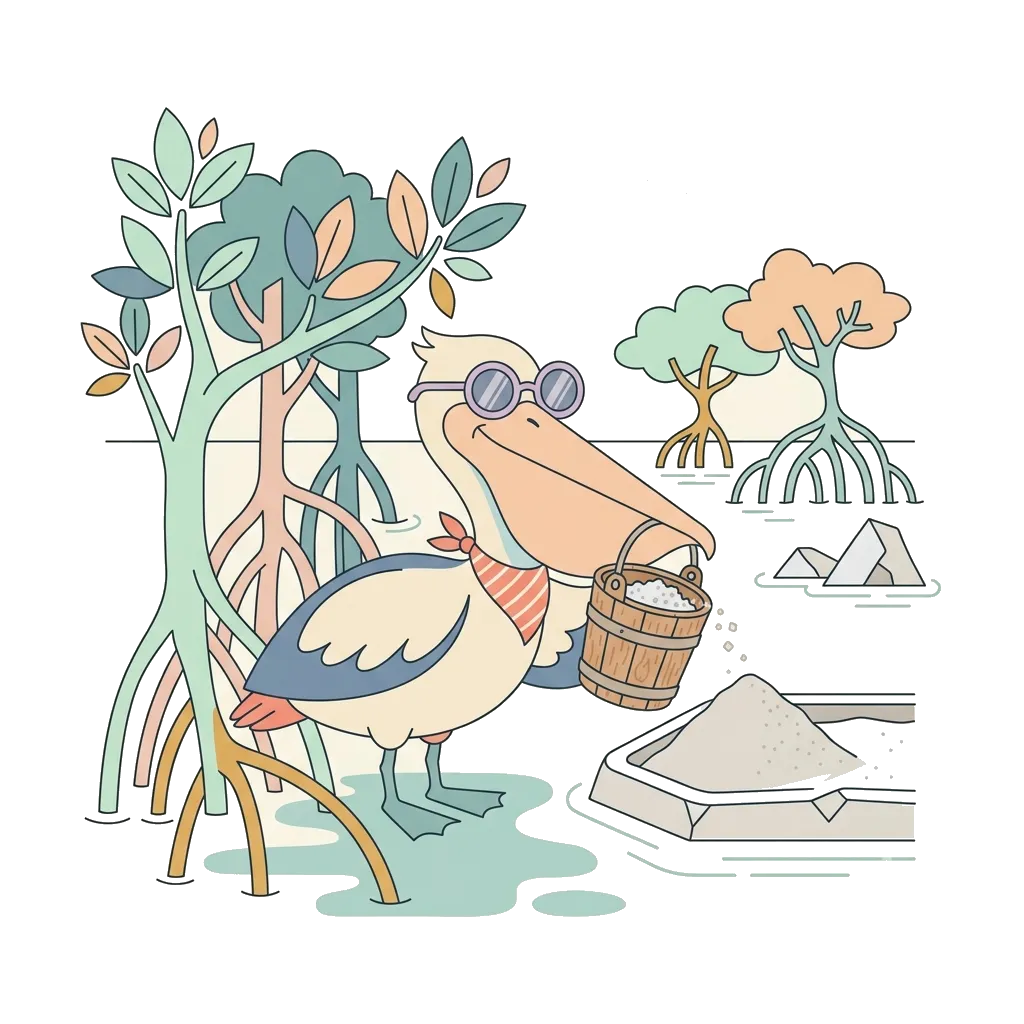
Mangrove trees have stilt roots that emerge from the water to capture oxygen, and pneumatophore roots that grow vertically toward the surface like a thicket of miniature snorkels. These unique adaptations allow them to colonise areas where few plant species survive. The mangrove acts as a natural nursery: its calm, nutrient-rich waters shelter young fish and crustaceans before they head out to sea. Without the mangrove, the ocean's commercial fish stocks would decline within a generation.
Globally, mangroves cover about 150,000 km² and are among the most productive ecosystems on the planet. They store up to four times more carbon per hectare than a tropical rainforest, earning them the name "blue carbon" — a distinction that makes their conservation a climate issue as much as a local one. The carbon they sequester is locked in their soils for centuries; when a mangrove is cleared, that store is released within months.
Grand-Popo's 1,500 hectares of living labyrinth
Grand-Popo's mangroves stretch mainly along the Mono River and around Bouche du Roy, the lagoon where the river meets the ocean. They cover about 1,500 hectares, forming a labyrinth of channels and islands that changes with the tides. No map of the mangrove is accurate for long.
Two mangrove species dominate: the red mangrove (Rhizophora racemosa) with its impressive stilt roots arching out of the water, and the white mangrove (Avicennia germinans) with pneumatophores standing like stalactites reversed. Their distribution follows salinity: red prefers fresher waters closer to the Mono's mouth, white tolerates more salt and grows in zones the ocean reaches more often. A third species, the white-leaf mangrove (Laguncularia racemosa), appears in sandier transitional zones, its lighter foliage easily missed unless you are looking for the colour difference.
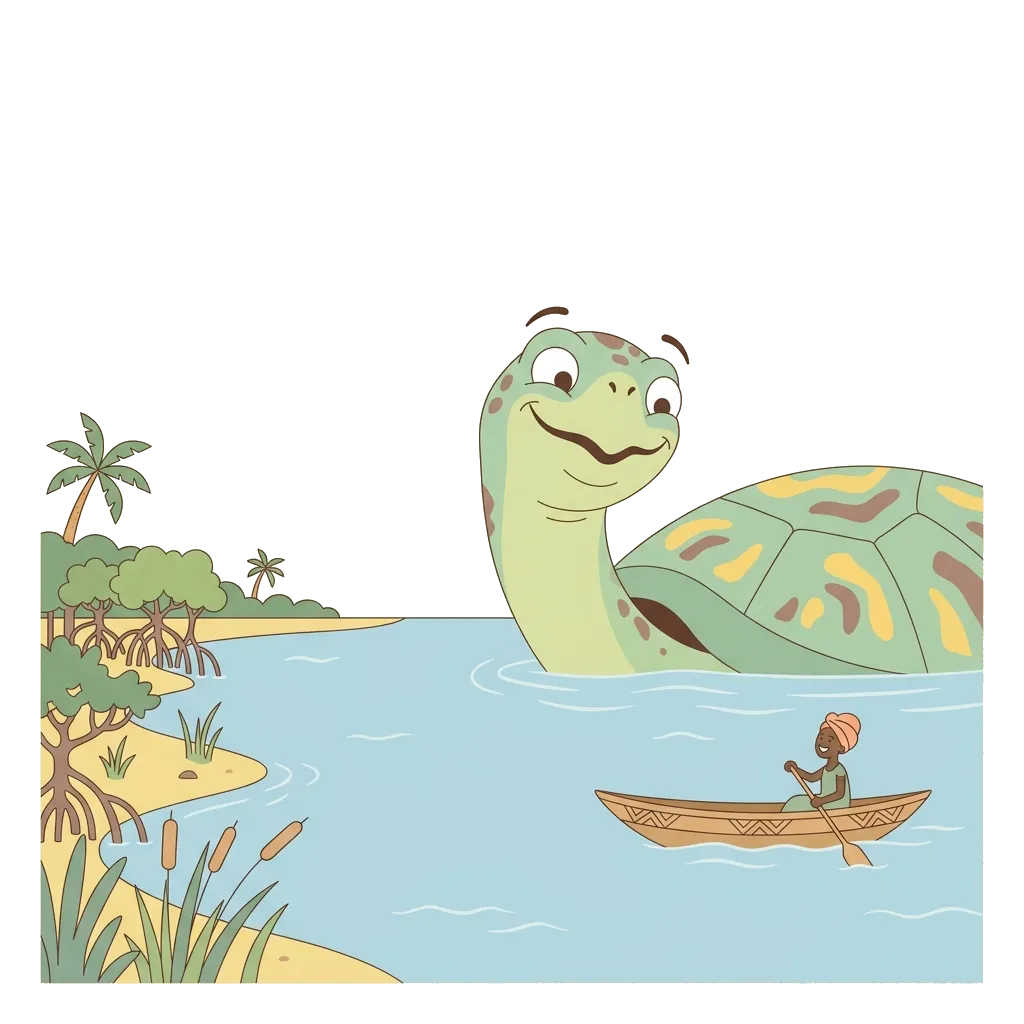
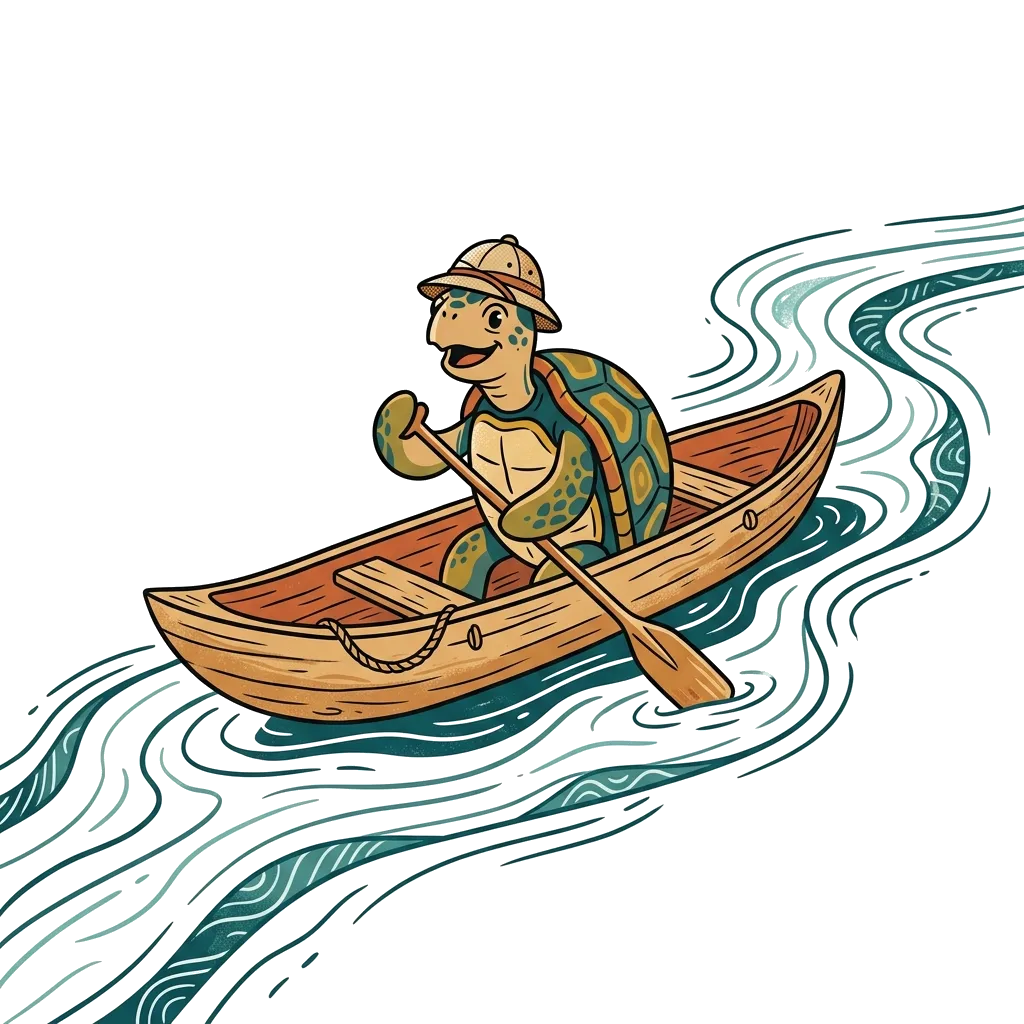
The mangrove channels are navigable by pirogue for 2 to 4 hours depending on the tide. The best time to visit is the dry season (November to March), when water levels are low and birds are most visible. At high tide, water rises to the lower branches, making navigation easier and the channels suddenly navigable where they were blocked hours before.
Paddle in silence along a narrow channel at low tide and the experience becomes intimate. The roof of intertwined branches filters the equatorial light into something almost amber. The air smells of iodine and wet earth — and underneath both, the richer, darker smell of ancient organic mud, the accumulated sediment of decades. Nothing moves except a grey heron lifting slowly from a root and a cloud of small fish scattering as the pirogue's shadow crosses their pool.
The forest that protects an entire coastline
Grand-Popo's mangroves play several essential ecological roles. They protect the coast against erosion by stabilising sediment with their roots. During storms, they act as a natural barrier, absorbing wave energy before it reaches inhabited land — a protection that is invisible until the day it is no longer there.
They are an exceptional biodiversity reservoir. Mangrove roots shelter young fish, shrimp and crabs that form local fisheries resources. Over 80% of commercial fish in the Gulf of Benin depend on mangroves for reproduction. A single tidal channel at low tide, examined carefully, teems with juvenile mullet, grey shrimp and fiddler crabs in numbers that seem impossible in such shallow water. The density of life per square metre in a healthy mangrove channel rivals that of a coral reef.
Mangroves contribute to climate regulation. Their organic soils store immense amounts of carbon in a form that stays locked for centuries. One hectare of Grand-Popo mangrove stores an average of 1,000 tonnes of carbon, equivalent to the annual emissions of 700 cars. Destroying one hectare releases that carbon back into the atmosphere within months.
Who lives in the roots
The Grand-Popo mangroves harbour an ecosystem that rewards patient attention. African manatees (Trichechus senegalensis), the gentle aquatic mammals that feed on aquatic plants and mangrove leaves, are regularly observed in the channels. Sightings are possible early in the morning, when they move into shallow areas to feed in the warming water. The manatee surfaces every three to four minutes to breathe; a small circular ripple and a brief grey snout, then nothing. Guides who know their feeding grounds will cut the motor fifty metres back and let the pirogue drift in.
Birdlife is exceptional. Herons, egrets, kingfishers and marsh raptors nest in the mangrove branches year-round. During the rainy season, European migratory birds stop here to rest and feed. Flamingos regularly visit the more open areas of Bouche du Roy. The dawn chorus in the mangrove is layered, complex, constantly changing — a soundscape that ornithologists describe as one of the richest on the West African coast.
Fiddler crabs (Uca tangeri) dig their burrows in the mud, waving their distinctive enlarged claw to attract females in a continuous semaphore. Mudskippers (Periophthalmus sp.) spend their lives between water and mud, a sight for observant visitors. These amphibious fish move across the mudbanks by propping themselves on their pectoral fins, pausing to watch you with their bulging eyes before retreating to their burrows at the first sign of a shadow. Look closely at the mudbank next to the pirogue and you may count a dozen species of invertebrates in a patch of silt no larger than your hand.
Threats and conservation
Grand-Popo's mangroves face several threats. Growing urbanisation and tourism development encroach on their area. Mangrove cutting for firewood and construction removes vegetation cover that took decades to establish. Plastic pollution, carried by the Mono River, accumulates in the roots, invisible from the channels but devastating to the organisms that live there.
Coastal erosion, accelerated by coastline retreat, weakens the mangroves closest to the ocean. Climate change, with rising sea levels and increasing storms, threatens this delicate balance in ways that cannot yet be fully predicted. Some sections of mangrove that locals remember as dense forest twenty years ago are now open water.
Conservation initiatives are in place. The "Mangroves of the Mono" programme, supported by international NGOs, organises replanting and community awareness. Fishermen are trained in sustainable resource management. Well-managed ecotourism contributes to funding these actions — a guided pirogue excursion is not just a leisure activity, it is a direct contribution to the people who protect these forests.
How to visit the mangroves
The best way to discover the mangroves is a pirogue excursion guided by a local fisherman. Departures are from Adjaha or Gbakpodji, depending on the tide. An excursion lasts 2 to 4 hours and costs 5,000 to 10,000 FCFA (8 to 15 EUR) per person.
The guide knows the channels, bird spots and areas frequented by manatees. Set off early (6-7 am) to enjoy the coolness and see the most active animals. Bring water, a hat, sunscreen and binoculars. Closed sandals are better than flip-flops if you need to step out of the pirogue at any point.
The tide strongly influences the experience. The ideal is to leave at rising tide: the water comes up, birds draw closer, and navigation is easier. Ask your lodge about the day's tide times the evening before so you can plan the departure accordingly. A falling tide on the way back reveals the full architecture of the roots — the channel seems to drain as you watch, exposing root networks that were invisible an hour earlier.
Photographing the mangroves
Mangroves are a prime photographic subject. The stilt roots create graphic patterns that repeat and vary along every channel. The light filtering through the mangroves produces atmospheres that shift from amber to green to almost silver as the angle of the sun changes. The best light is in the morning (6-8 am) and late afternoon (4-6 pm).
A versatile lens (24-70 mm) is ideal for the forest itself. For birds, a telephoto lens of at least 200 mm is necessary. Image stabilisation is important as you will be shooting from a pirogue that moves gently even when the guide has stopped paddling.
Follow the rules: no flash in animal observation areas, do not touch the mangroves and take nothing. Your passage should leave no trace except the small wake the pirogue makes behind you.
Supporting preservation
Visiting the mangroves with a local guide is already a supportive gesture that feeds directly into the local economy. You can go further by joining a replanting day organised by local associations. Several partner lodges offer this activity on request, and it takes only a morning.
Avoid motorised excursions (outboard motors) in the channels: paddle-powered or electric pirogues are far less disturbing for wildlife. The sound of an outboard motor clears a channel of birds within minutes and keeps them away for hours. Refuse juvenile fish or crustaceans offered in restaurants — they represent future stock.
Donations to local conservation associations are welcome. Even 5,000 FCFA (7.60 EUR) can plant about ten mangroves and ensure their monitoring for a year. A small contribution that pays dividends in carbon stored, fish raised and coastline held.
Plan Your Visit
Discover the magic of Grand-Popo with our curated local experiences.